
Last updated on: June 15, 2026
You sit down on a Saturday night, remember a movie you’ve been wanting to watch, open Netflix, and… it’s gone. Your friend says, “Oh, I watched that on Netflix last month,” but now you can’t find it anywhere on the platform. You check Prime Video. Not there either. Disney+? Nope.
This happens to millions of people every single week, and it feels incredibly frustrating.
A situation every streamer faces
This isn’t a Netflix problem. It’s not a Prime Video problem. It’s a problem that every single streaming platform wrestles with constantly. Movies and shows disappear and reappear with no warning, no explanation, and no pattern you can predict. One day it’s there. The next day—poof—gone.
Why it feels confusing and frustrating
Here’s why you feel so frustrated: you assumed Netflix, Prime, and Disney+ owned their entire libraries. You figured if something is on their platform, it’s theirs to keep forever. That’s a totally reasonable assumption. But that assumption is completely wrong.
The truth is, the vast majority of content on these platforms isn’t owned by Netflix, Amazon, or Disney. It’s rented. Temporarily. For a limited time. And when that time expires, the movie leaves the platform legally and technically it has to go.
What most people assume (and why it’s wrong)
Most people think one of three things:
-
“Netflix removed it on purpose because I watched too much” — Nope.
-
“The movie is now exclusive to another platform and doesn’t exist on Netflix” — Sometimes, but that’s not the main reason.
-
“If it’s not on Netflix, it must be illegal to watch anywhere” — Completely wrong. It’s probably on a free platform you’ve never heard of.
The real reason is far less dramatic: contracts expired, licensing costs became too expensive compared to how many people actually watched it, or the studio that owns the film pulled it to put it on their own streaming service.
What this article will explain clearly
By the end of this article, you’ll understand exactly why your favorite movies vanish, where they actually go, and how to find them. You’ll know the difference between temporary licensing and permanent ownership. And most importantly, you’ll realize that just because a movie isn’t on Netflix doesn’t mean you can’t watch it.
Streaming Platforms Don’t Own Most Movies
This is the biggest misunderstanding about streaming, and it changes everything once you understand it.
Difference between hosting and owning
When you own something physical—a book, a DVD, a house—you own it forever. You can sell it, give it away, or let it sit in your attic for 50 years. That’s ownership.
Netflix doesn’t own most of its movies. Instead, Netflix hosts those movies. It pays for the right to stream them to you for a specific period of time. The studio that made the movie still owns it. Netflix just rents the right to show it.
Think of it like this: Netflix is renting a movie from a theater, not buying the theater itself.
How licensing actually works
When a studio releases a movie, they make money in several ways:
-
Theatrical release — People pay to see it in cinemas
-
DVD/Blu-ray sales — People buy the physical copy
-
TV broadcasts — Cable networks pay to show it
-
Streaming rights — Streaming platforms pay to let people watch it
Each of these is a separate contract negotiated separately. Netflix doesn’t automatically get all of these rights. They pay for streaming rights in specific regions for a specific amount of time.
For example, Netflix might pay $5 million for the right to stream a popular action movie in the United States for 18 months. After those 18 months are up, Netflix loses that right unless it pays again.
The contract might also say the movie is only available in the US, UK, and Canada—not in India or Brazil. It’s all negotiated separately based on the value of the movie and how many people in that region might watch it.
Why Netflix ≠ permanent movie library
Here’s the brutal truth: Netflix is not a permanent library. It’s more like a rotating display at your local video rental store, except the display changes without warning.
Netflix doesn’t have the money to license every movie forever. Imagine if Netflix had to pay for permanent streaming rights to 5,000 movies indefinitely—the cost would be astronomical. So instead, they pay for temporary access. When the contract ends, the movie leaves.
The studio gets to resell those rights. Maybe Amazon Prime pays for the next window. Maybe the studio puts it on their own platform (like Disney puts movies on Disney+). Maybe it goes to a free streaming service. But Netflix doesn’t keep it forever unless they own the movie themselves. where to watch movies you can’t find on Netflix
Licensing Rights Are the #1 Reason Movies Disappear
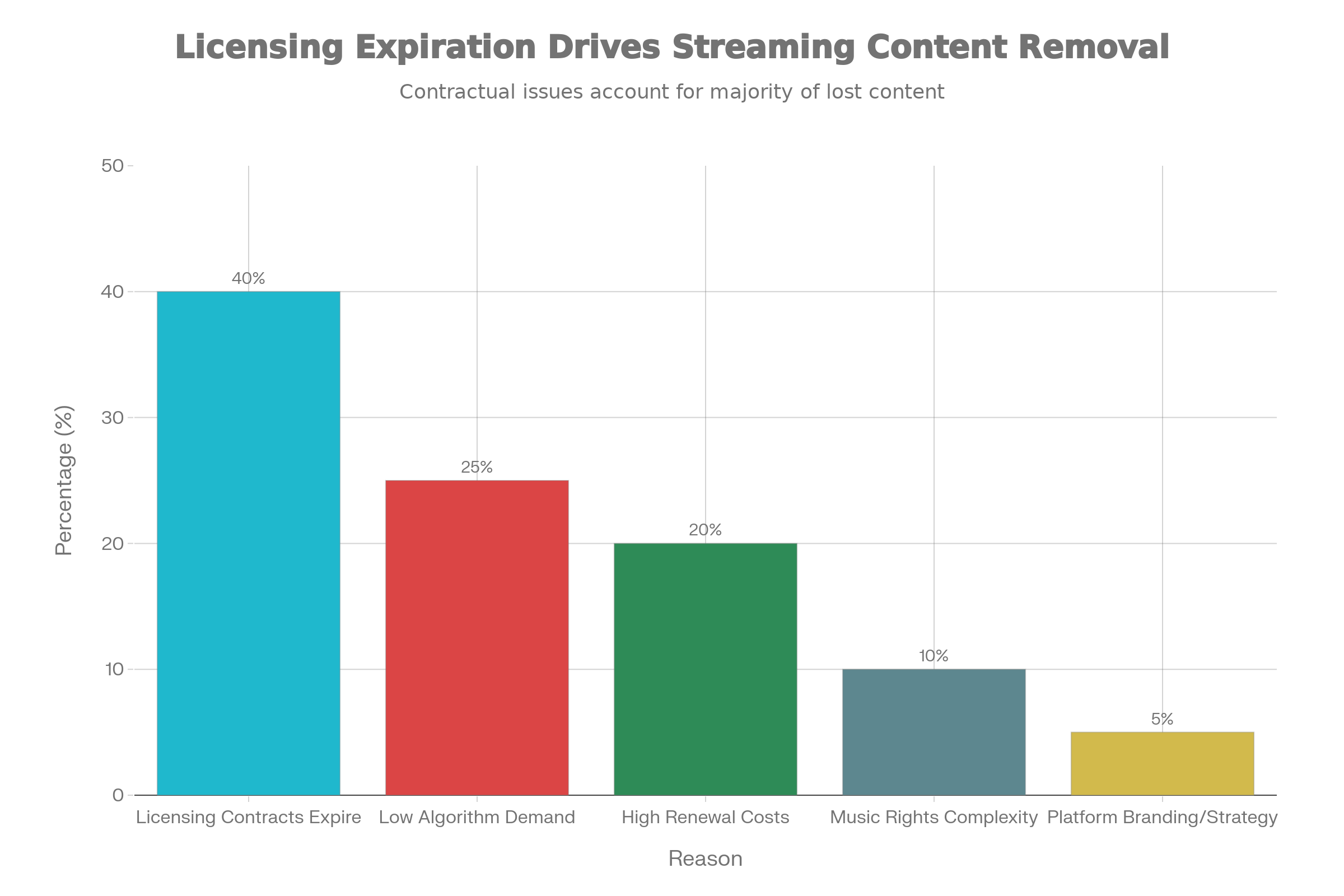
If you want to understand why your favorite movie left Netflix, licensing is the answer 95% of the time.
Time-Limited Streaming Licenses
When a streaming platform licenses a movie, the contract always has an expiration date. Always. Never perpetual. Never forever.
Fixed contracts (6 months, 1 year, etc.)
The contracts vary wildly. Some movies are licensed for just 6 months. Others for 2 years. Some for 5 years. But every single contract expires.
Netflix’s data shows us this clearly. In 2026 alone, Netflix removed over 100 of its original movies and TV shows because the licensing agreements with the studios expired. This wasn’t Netflix’s choice—it was legally required to remove them.
When the contract expires, Netflix gets a notice. It says something like: “Your licensing agreement for The Crown expires on March 15, 2026. After that date, you may no longer stream this title.”
Why movies rotate out quietly
Netflix doesn’t announce when movies are leaving. Prime Video doesn’t send you a warning email. Disney+ doesn’t put up a banner.
Why? Because the studios negotiate it that way. The contract often includes language that says: “Netflix cannot promote the upcoming removal of this title to subscribers.” So Netflix complies silently, and millions of people are shocked to find their favorite movie gone.
Sometimes Netflix does warn you—if you search for a movie leaving soon, Netflix will tell you it’s “leaving soon.” But it doesn’t proactively tell millions of users, “Hey, we’re losing this movie.”
It’s like they’re sneaking out the back door instead of announcing their departure.
Regional Licensing Restrictions
Here’s something that will blow your mind: the same movie exists on Netflix in one country but doesn’t exist on Netflix in another country. Not because the movie is unavailable—because the licensing contracts are country-specific.
Why a movie exists in one country but not another
Netflix US might have bought the streaming rights for The Godfather in the United States. But a different company in the UK bought the streaming rights there, and that company licensed it to a different platform.
The movie isn’t gone. It’s just not available to you in your location because the rights holder sold the rights to someone else in your region.
This is why your friend in Canada can watch a movie on Netflix Canada that you can’t watch on Netflix USA. It’s not a mistake. It’s intentional. The studio sold the Canadian streaming rights to someone else.
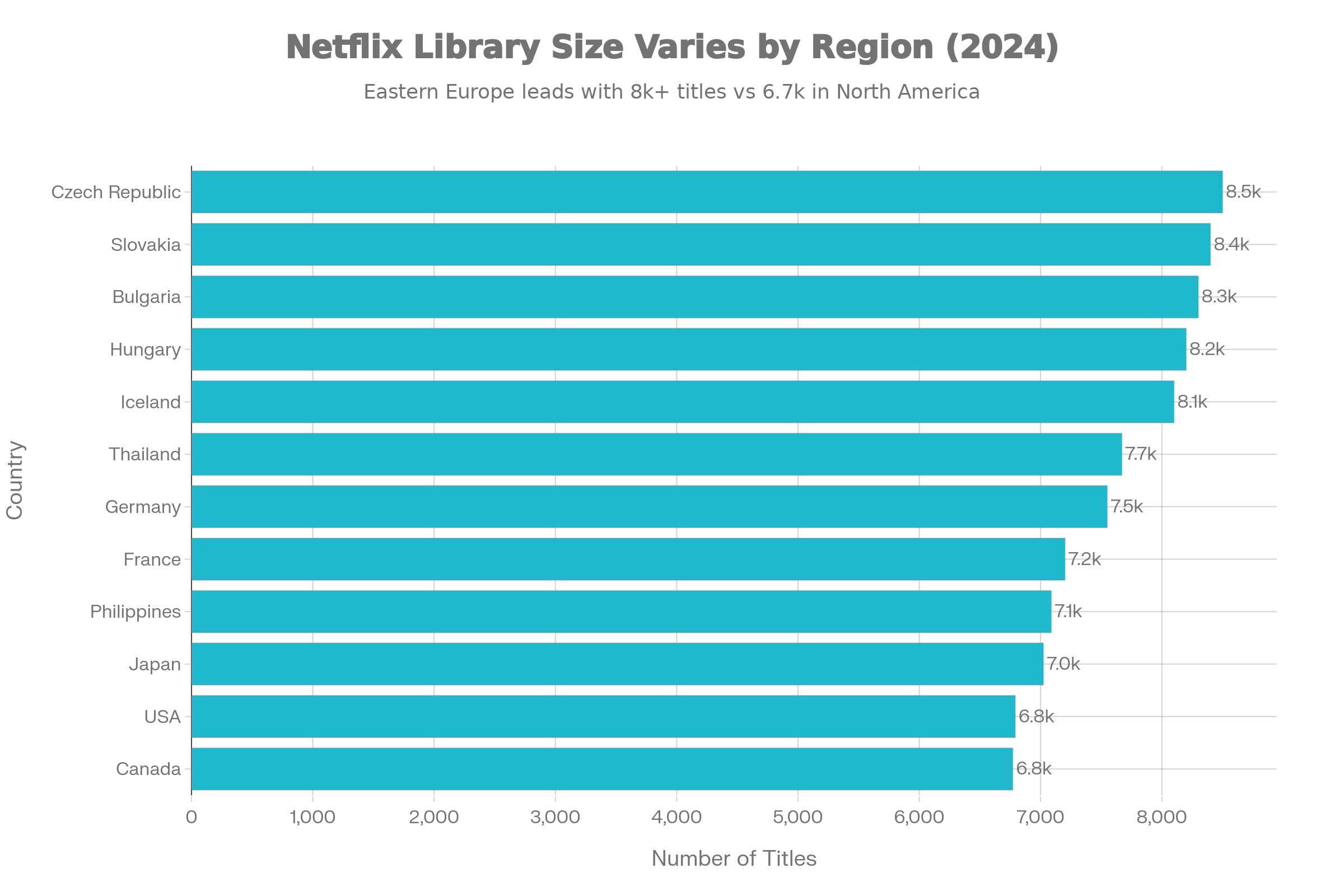
Netflix’s own data shows the dramatic differences:
-
Czech Republic Netflix library: 8,500+ titles
-
Philippines Netflix library: 7,088 titles
-
Canada Netflix library: 6,771 titles
-
USA Netflix library: 6,791 titles
Same platform. Same company. Wildly different content based on where you live. All because of regional licensing agreements.
How geography controls availability
Here’s how it works from the studio’s perspective: A studio owns a movie. They want to make as much money as possible from that movie. So they divide the world into territories: North America, Europe, Asia, etc.
Then they auction off the streaming rights to each territory separately. Netflix might bid $5 million for North American rights. Amazon Prime might bid $3 million for European rights. A local platform in India might bid $2 million for Asian rights.
Each company gets exclusive rights in their territory for their specific time period. This is why the same movie is on different platforms in different countries. It’s the most profitable way for studios to distribute their content.
Low Demand = High Risk for Removal
Here’s the harsh reality that Netflix doesn’t want you to know: Netflix tracks every single movie you watch. Not just if you watch it, but when you stop watching, which device you use, whether you finish it.
Algorithm-driven decisions
Netflix has an algorithm that predicts which movies are worth keeping and which movies should be removed to save money.
When a licensing contract is about to expire, Netflix doesn’t ask “Do we legally have to remove this?” They ask: “Should we pay money to renew this license?”
To decide, they pull up their data. How many people watched this movie in the past year? How many people started it but didn’t finish? How many people added it to their watchlist but never clicked play? How long did the average person watch before giving up?
If the numbers are terrible, Netflix doesn’t renew the license. It’s that simple. The studio asks for $2 million to renew the rights for another year. Netflix’s data shows only 50,000 people watched it last year, and most of them quit halfway through. Netflix says, “No thanks. We’ll spend that $2 million on something else.”
Why niche, old, or slow-watched films get dropped
Indie films, documentaries about obscure topics, and movies from 30 years ago don’t draw massive numbers. They have passionate fans, but the fan base is small.
When you have a passionate but small fan base, you’re expensive to keep. Netflix has 301 million subscribers. Even if 100,000 people loved that weird indie film from 2010, that’s only 0.03% of the user base. Netflix can’t afford to keep content that interests a tiny sliver of users.
Why popularity matters more than quality
This is the brutal truth: popularity matters infinitely more than quality. A mediocre movie that 10 million people will watch gets renewed. A masterpiece that 50,000 cinephiles adore gets removed.
It’s all data. It’s all math. It’s all ROI (return on investment). Netflix doesn’t care if a movie is a Criterion Collection classic. They care if it drives subscriptions or keeps existing subscribers watching.
Why Older and Classic Movies Are Often Missing
You’d think old movies would be cheaper to keep on Netflix. They’ve been out for decades. The production costs are sunk. The hype has died down.
Wrong. Old movies are sometimes the most expensive to keep on streaming platforms because the rights situation is a nightmare.
Complicated ownership rights
When a movie was made in 1975, the contracts were written for theatrical release, TV broadcast, and home video. No one anticipated streaming. So now, the rights are fractured.
The studio might own the visual rights. But who owns the music? Was that licensed for theatrical release only? Are there additional payments required for streaming? Who owns the director’s vision? Who owns the actors’ likenesses?
For a movie made 40 years ago, the answers to these questions are scattered across dozens of contracts, many written on paper that’s crumbling in storage.
Studios that no longer exist
Some movies were made by studios that don’t exist anymore. They were acquired, merged, or went out of business.
If a studio went out of business, who owns the rights now? Sometimes no one knows. Sometimes the rights are genuinely lost. Sometimes they’re disputed. You can’t license rights you can’t find.
Rights lost, sold, or disputed
For older films, rights are often lost to time. A producer dies. The production company’s records are destroyed. The rights change hands so many times that the current owner isn’t even clear.
To stream an old movie, Netflix has to verify it owns the streaming rights. If the rights are disputed, Netflix can’t risk a lawsuit. It’s just safer to remove the film.
Why no one wants to manage them
Here’s the ugly truth: old movies are expensive to re-license. The music licensing alone can be brutal.
Imagine a 1975 film with 30 songs. Some songs are from the 1960s. To stream this movie, Netflix needs permission from:
-
The film studio (for the visual content)
-
Each music copyright holder (for the right to use the song)
-
Each music performer (for royalties)
-
Possibly the original actors (for residual payments)
The licensing fees could easily exceed the money Netflix makes from that old movie. So Netflix removes it instead.
Indie, Foreign, and Festival Films Get Left Behind
Streaming should be democratic. Any filmmaker anywhere should be able to reach 200 million Netflix subscribers. But that’s not how it works.
The reality is, indie films, foreign films, and festival darlings are systematically deprioritized by major streaming platforms.
Limited distribution deals
When you make an indie film with a $100,000 budget, you can’t negotiate with Netflix. Netflix negotiates with studios. So your indie film gets distributed by a small distributor who maybe got the rights to your movie for a few years.
That small distributor negotiates with Netflix on your behalf. The deal is tiny by Netflix standards. Maybe Netflix pays $50,000 for the streaming rights. In two years, the contract expires. The distributor moves on. Your film disappears.
Small production budgets
Indie films have no leverage. If you made a $500 million Marvel movie, you’re Disney. Netflix has to license it or their subscribers will leave. If you made a $100,000 indie film, Netflix doesn’t need you. There are 10,000 other indie filmmakers.
So indie films get worse deals. Lower licensing fees. Shorter contract lengths. Less prominence on the platform.
Why big platforms ignore them
Netflix’s algorithm doesn’t know about your small indie film. You haven’t got a marketing budget. You haven’t got a distributor with relationships at Netflix.
According to our research, only 0.03% of Netflix’s user base might watch your indie film. That’s invisible to the algorithm. The film gets zero recommendations. Zero homepage placement. Zero visibility.
Then, when the contract expires, Netflix lets it go without a second thought.
Where they usually end up instead
Here’s the good news for indie filmmakers: there are platforms built specifically for them.
-
MUBI — A curated streaming service for indie, international, and classic films. You get a new film every day, available for 30 days.
-
IndieFlix — Streams indie films and pays filmmakers based on minutes watched (royalty pool model).
-
FilmDoo — A UK-based VOD platform focused on world cinema and indie films.
-
Criterion Channel — Focuses on classic and arthouse cinema from around the world.
-
Tubi — Free service with over 40,000 titles, including tons of indie and foreign films.
If you want to find indie and foreign films, these platforms are goldmines that Netflix doesn’t promote.
Some Movies Are Too Expensive to License
Not every movie leaves Netflix because it’s unpopular. Sometimes Netflix would love to keep it, but the cost is just insane.
Music rights inside films
This is the killer. A movie from the 1980s has 40 songs in the soundtrack. Maybe 30 of them are licensed for theatrical release only, not for streaming.
To put that movie on Netflix, the studio needs to renegotiate the music licenses. That means paying the rights holders again. For a popular song, that could be $100,000+. For 30 songs, you’re looking at millions of dollars.
But how many people will watch that 1980s action film? Maybe 100,000 in a year. That’s $5-10 per viewer to stream it. Netflix does the math and says, “Not worth it.”
Actor residuals
Here’s a hidden cost: actors get paid again when movies are rerun. It’s called residuals.
When Netflix streams a movie, the actors should technically get paid residuals. The amount is negotiated in their original contracts. For old movies with established stars, those residual payments can be significant.
If an old movie has a major star, the residuals alone might make renewal too expensive.
Renewal cost vs ROI
Netflix runs the numbers. “To renew the license for Movie X costs $3 million. In the past year, 2 million people watched it. That’s $1.50 per viewer. If we renew, maybe 2 million people watch again next year. ROI is barely positive. We’ll lose money renewing. Decision: Remove the movie.”
Meanwhile, they could spend that $3 million on a brand-new Netflix Original with better algorithms and more marketing potential.
Why platforms say “not worth it”
Streaming economics are brutal. Every dollar spent on licensing is a dollar that could go toward marketing, technology, or original content.
Netflix has 301 million subscribers. To make a movie renewal worth it, the renewal cost has to be low enough that the revenue from that movie exceeds the cost. For niche or old content, that math rarely works out.
Platform Branding and Content Strategy
Not every removal is about money. Sometimes it’s about identity. Sometimes it’s about image.
Why family-friendly platforms avoid certain films
Disney+ built its brand as a family-friendly service. Wholesome content. No profanity. No intense violence. No nudity.
When Disney+ added Marvel’s “Daredevil” series—which has profanity, intense violence, and mature themes—they had to add parental controls to protect that family-friendly image.
But here’s the thing: Disney+ also occasionally removes content that doesn’t fit its brand. If a film is rated R and has content that clashes with the Disney brand, Disney might just remove it rather than promote it to families.
Image control
Every brand has an image. Hulu is for edgy content. Disney+ is for families. Netflix is for everyone. Amazon Prime is for everyone-but-cheaper.
When content conflicts with that image, platforms remove it. Not because it’s unpopular, but because it doesn’t fit.
Target audience mismatch
Netflix licensed a British art-house film. But Netflix’s algorithm showed that the film wasn’t being recommended to anyone, because no one’s viewing history matched it. So when the license was about to expire, Netflix didn’t renew it.
Why? Because the film’s target audience—serious film buffs—weren’t discovering it on Netflix’s algorithm-driven platform. Netflix lost money promoting a film no one found.
This is why quality doesn’t matter. It’s about algorithm match and audience alignment.
Movies Don’t Disappear—They Just Move
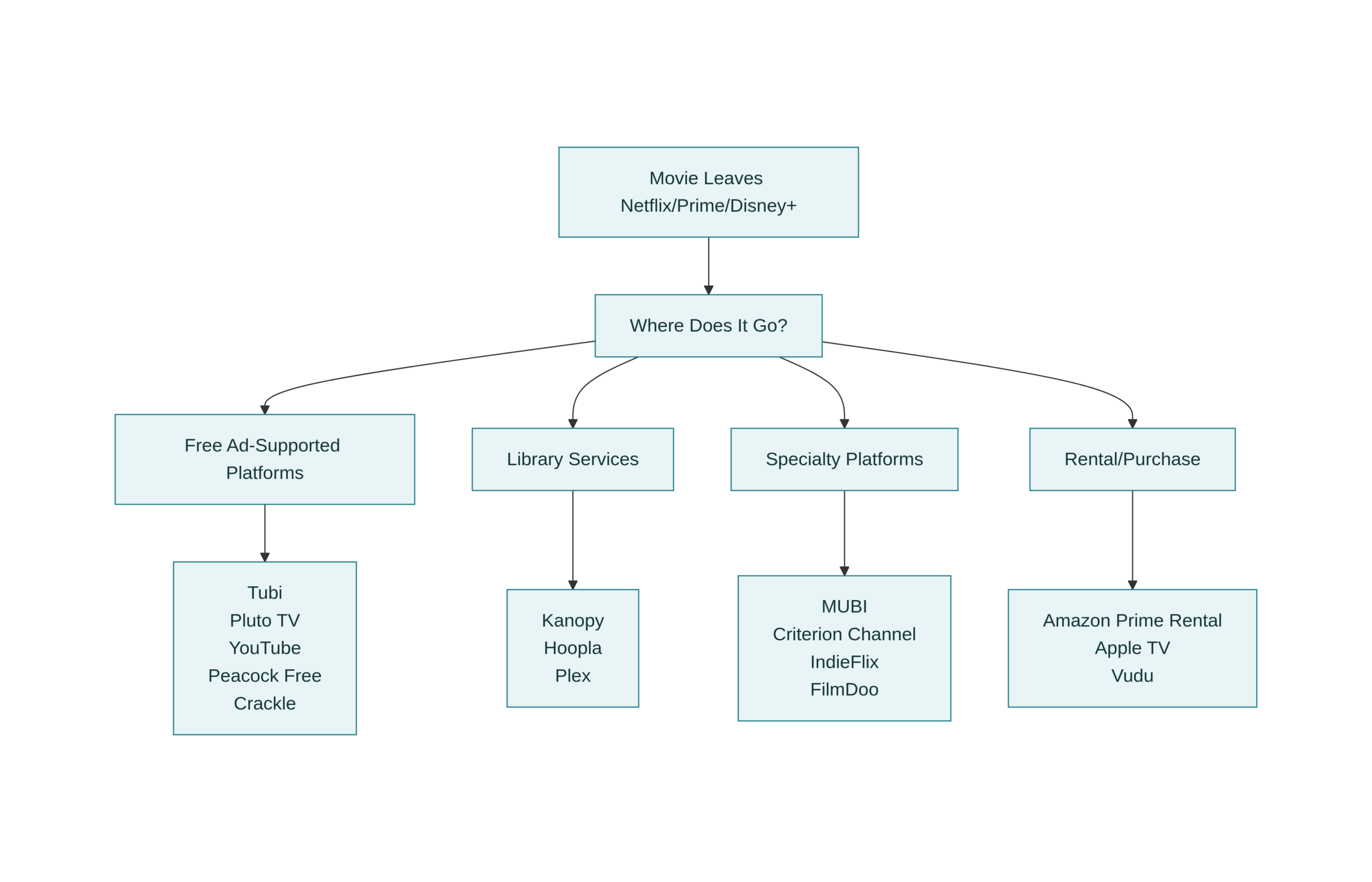
Here’s the secret that Netflix, Prime, and Disney+ don’t want you to know: when movies leave those platforms, they don’t vanish. They move.
Sometimes they move to another streaming platform. Sometimes they move to a free ad-supported service. Sometimes they move to a platform you’ve never heard of.
But they’re out there. Waiting for you to find them.
Where missing movies usually go
When a movie leaves Netflix, here are the most likely destinations:
Free Ad-Supported Platforms (AVOD)
-
Tubi — Over 40,000 movies and TV shows, completely free with ads. This is where thousands of movies from Netflix end up. Tubi focuses on films with smaller audiences—indie, foreign, horror, B-movies.
-
Pluto TV — Over 425 live channels plus on-demand content. It mimics traditional cable. Free with ads. Huge archive of older films.
-
The Roku Channel — Free, ad-supported. Over 500 channels dedicated to specific genres and interests.
-
YouTube — Many movies are free on YouTube with ads.
-
Peacock — NBC’s service has free tier with ads and paid tier without.
-
Crackle — Sony’s free service with ads.
Library-Based (Usually Free With Library Card)
-
Kanopy — Requires a library card from participating libraries. Thousands of films, documentaries, and TV shows. No ads.
-
Hoopla — Library service with movies, TV, music, and more.
-
Plex — Free service with its own TV-like interface. Growing library.
Specialty Streaming Platforms
-
MUBI — For indie, international, and classic cinema. $10/month or $95/year.
-
Criterion Channel — Curated classic and arthouse films. $9.99/month.
-
Sundance Now — Indie and arthouse cinema from Sundance Film Festival.
-
MHZ Choice — International films and TV, ad-free.
Rental Services (Pay Per View)
-
Amazon Prime Video — You can rent movies you don’t have access to for $3.99-$6.99.
-
Apple TV — Same model.
-
Vudu — Free with ads, or rent/buy individual titles.
Why people don’t notice these platforms
The problem is visibility. Netflix is famous. Tubi is not.
When you’re looking for a movie, your brain immediately goes to Netflix, Prime, or Disney+. These are the platforms you pay for. You don’t think about Tubi, Pluto TV, or Kanopy because they’re not as famous.
But the films are there. Right now. Waiting.
Common Myths About Missing Movies
Let’s bust three myths right now.
“Netflix has everything” ❌
Netflix has about 6,700 movies and TV shows available in the US at any given moment. That sounds like a lot until you realize there are millions of films ever made.
Netflix doesn’t have everything. Netflix has a carefully curated selection of content based on:
-
Licensing costs
-
Algorithm predictions
-
Brand alignment
-
Regional demand
“If it’s not there, it’s illegal” ❌
This is so wrong. Movies don’t disappear—they move. Just because a film isn’t on Netflix doesn’t mean you can’t watch it legally.
It might be on Tubi (free with ads). It might be on your library’s Kanopy service (free with library card). It might be available to rent for $3.99. It might be on three other streaming platforms you’ve never heard of.
The film is legal. It’s just not on Netflix.
“Old movies don’t matter anymore” ❌
This is what Netflix wants you to think. But old movies are valuable. Criterion Collection releases old films. Streaming platforms like MUBI focus on classic cinema.
The issue isn’t that old movies don’t matter. It’s that licensing them is complicated and expensive. So Netflix removes them, and specialty platforms step in.
Movies go missing from Netflix and Prime mainly due to licensing agreements that expire after a fixed period, regional rights restrictions, low demand based on viewing algorithms, and high renewal costs. Streaming platforms rotate content constantly, meaning many films move to free or niche platforms instead of disappearing entirely. The movie isn’t gone—you’re just looking in the wrong place.
Why This Will Keep Happening in the Future
If you think content removal is bad now, get ready. It’s going to get worse.
Streaming market saturation
There are now dozens of streaming platforms: Netflix, Disney+, Prime Video, Hulu, Max, Peacock, Paramount+, Apple TV+, Crunchyroll, MUBI, Tubi, Pluto TV, and dozens more.
Studios are pulling their content from neutral platforms like Netflix to put it on their own services (Disney+, Max, Peacock). This fragments the market. Your favorite movie might be on a platform you don’t subscribe to.
Rising licensing costs
When Netflix started, licensing deals were cheap. Studios were happy to get any streaming revenue. Now, streaming is the dominant form of entertainment. Studios know streaming is valuable, so they charge more.
Licensing costs have tripled in many cases. A film that cost $1 million to license five years ago might cost $3 million today. Netflix has to cut costs somewhere, so less popular films get removed.
Subscription fatigue
People are tired of subscribing to 8+ streaming services. They’re canceling. Deloitte predicts that “SVOD stacking has reached its limit and will start declining in 2025.”
As subscriptions decline, streaming platforms have less money to spend on licensing. They prioritize big blockbusters and original content. Niche films get removed.
Growth of free streaming platforms
Tubi, Pluto TV, and others are exploding in popularity because they’re free. By 2028, ad-supported streaming (FAST) will account for 28% of streaming revenue, up from 20% in 2023.
The future isn’t Netflix with a huge library. It’s a fragmented landscape where:
-
Netflix focuses on premium original content
-
Disney+ focuses on Disney properties
-
Studios run their own platforms
-
Free, ad-supported services pick up the remainder
Conclusion
Your favorite movie didn’t disappear. It moved.
When your movie leaves Netflix, it goes somewhere. Maybe Tubi. Maybe Pluto TV. Maybe your library’s Kanopy service. Maybe a specialty platform like MUBI. Maybe it’s available to rent for $3.99.
The film still exists. It’s still legal to watch. You just have to know where to look.
Short recap
Movies leave Netflix because:
-
Licensing contracts expire (the #1 reason)
-
Netflix’s algorithm says it’s not popular enough to renew
-
Renewal costs are too high
-
Music rights make renewal impossible
-
The film doesn’t match the platform’s brand
-
Studios pulled it to put it on their own service
You’re not losing access to movies. You’re just entering a more fragmented world where you need to check multiple platforms.
Your library card gives you free access to Kanopy. You can watch thousands of movies on Tubi for free. Pluto TV has 425 live channels of classic content. If you know where to look, you’ll find almost any movie.
The ecosystem isn’t broken. It’s just different than what Netflix taught you to expect.
Next time a movie disappears from Netflix, don’t assume it’s gone. Use services like JustWatch or ReelGood to search across all streaming platforms at once.
Your library probably has Kanopy. Check it. Download the Tubi app. See what’s available. Use YouTube to search for free movies.
The films are out there. You just have to be smarter about how you search for them.
And finally, remember this: the fragmented streaming landscape is actually a blessing if you’re willing to explore. Netflix is one algorithm. But Tubi, MUBI, Criterion, and specialty platforms have human curators who choose films based on quality, not just algorithm metrics.
Sometimes the best movies aren’t on Netflix. They’re waiting for you on the platforms Netflix didn’t tell you about.