
Last updated on: June 8, 2026
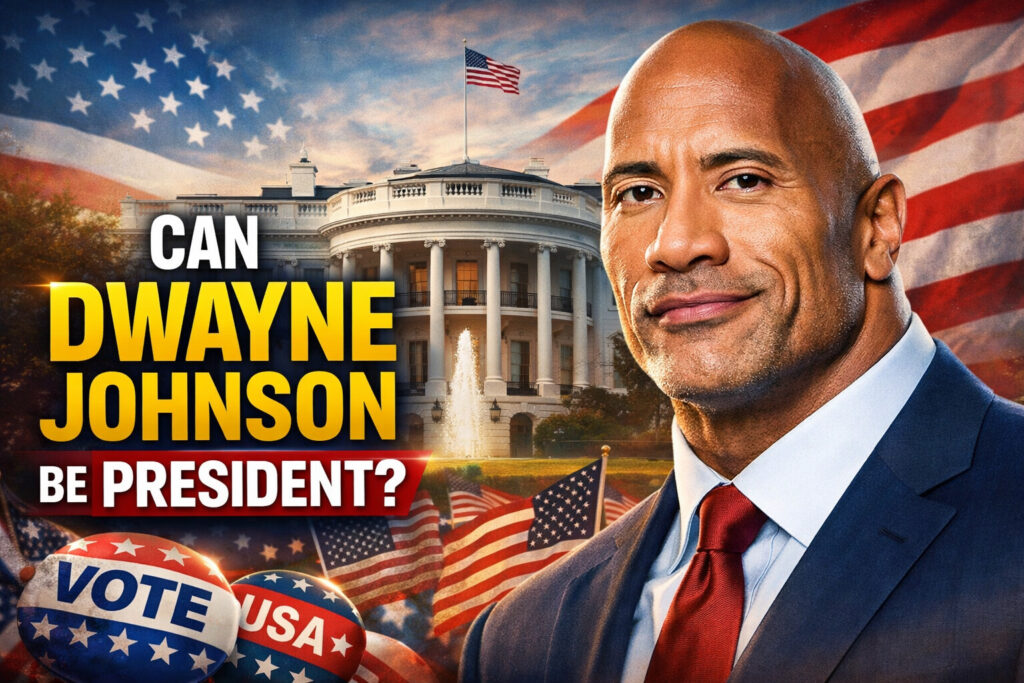
You’ve probably heard it before. Someone’s scrolling through social media, sees Dwayne “The Rock” Johnson’s latest inspirational post to his 391 million followers, and the thought pops into their head: “Why isn’t this guy running for president?”
It’s a question that’s taken on real weight in modern American politics. We’ve seen it happen before. A celebrity with massive name recognition and charisma steps out of the entertainment world and into the Oval Office. Donald Trump did it. Ronald Reagan did it. So why not The Rock?
Here’s what’s driving this conversation. First, there’s the broader trend of celebrity politicians rising in democracies worldwide. Traditional politics feels broken to many people—divided, corrupt, ineffective. A successful outsider who’s known for getting things done? That appeals to voters exhausted by the political establishment. Second, Dwayne Johnson himself has kept this idea alive. He’s not dismissed it outright. He’s hinted at it, joked about it on TV shows, even featured a fictional version of himself running for president in 2032 in his NBC series “Young Rock.” Third, there’s genuine public enthusiasm. A 2021 poll found that 46% of Americans would support a presidential run from Johnson. That’s higher than many actual political figures.
But there’s a massive gap between “That would be cool” and “This could actually happen.” This article breaks down the reality: legally, practically, and politically. By the time you’re done reading, you’ll understand not just whether Dwayne Johnson can be president, but whether he should, and whether you’d actually vote for him if he did.
Who Is Dwayne Johnson Beyond Hollywood?
From WWE Superstar to Global Icon
You can’t understand Dwayne Johnson’s political potential without understanding how he became one of the most recognized people on the planet. He didn’t start in Hollywood. He started in wrestling.
Johnson spent years in WWE (World Wrestling Entertainment) as “The Rock,” becoming a household name in the late 1990s and early 2000s. He won 10 heavyweight championships and became known for something that would later define his entire brand: connecting with everyday people. His promos—his microphone speeches in the ring—were legendary. He was funny, self-deprecating, and relatable despite being a massive physical specimen. Fans didn’t just watch him; they felt like they knew him.
From there, he transitioned to Hollywood. The move worked because he brought his wrestling authenticity with him. He wasn’t trying to be a serious dramatic actor. He was The Rock—the same charismatic guy from the ring, just now in action movies and comedies. Films like the “Fast and Furious” franchise, “Jumanji,” and “Black Adam” made him one of the highest-paid actors in the world.
But here’s what makes Johnson different from other celebrities. He didn’t stop at acting.
Business Ventures and Brand Power
Johnson has built an empire. In 2020, he launched Teremana Tequila. Here’s where it gets interesting: his brand became the fastest premium spirits brand ever to sell one million 9-liter cases in a single year in the United States. That’s not celebrity vanity branding. That’s real business success built on genuine quality and marketing.
He owns production companies. He’s invested in fitness and wellness ventures. Everything he touches seems to turn profitable, and more importantly, his name adds real value—not just buzz, but actual revenue. For a potential presidential candidate, this matters. It shows you can execute. You can build something. You understand business, operations, and how to scale an organization.
His Public Image and Trust Factor
Here’s the thing about Dwayne Johnson that separates him from most other celebrities: people think he’s real.
Walk through any social media conversation, and you’ll see it. Johnson posts about his workout routines (obsessively), his family, his business ventures, his morning walks, his “cheat meals”—and people believe he’s actually like that. His Instagram followers number 391 million, and his engagement rate is higher than most celebrities because his content feels authentic. He responds to fans. He celebrates others’ victories. He shares his struggles.
This authenticity matters in politics. Voters don’t just vote on policy anymore—if they ever did. They vote on whether they trust someone. Does this person seem like they’ll actually help people, or are they in it for themselves? Johnson’s public persona—whether it’s entirely real or carefully crafted—is that of someone who genuinely cares.
But here’s the critical distinction: being likable on social media is different from being trusted to run a country. His leadership perception is based on his acting persona and motivational content, not on actual governing experience. That gap is substantial.
What Are the Legal Requirements to Become US President?
Let’s get the basic stuff out of the way first, because it matters.
Constitutional Criteria Explained Simply
The U.S. Constitution sets exactly three requirements for the presidency:
1. Natural-born citizen: You must be a U.S. citizen by birth, or be a legitimate child of a U.S. citizen born abroad. The idea was to prevent foreign allegiances.
2. Minimum age: You must be at least 35 years old.
3. Residency: You must have lived in the United States for at least 14 years.
That’s it. The Founders wanted it simple and difficult to game. If you meet these three criteria, you’re constitutionally eligible. Everything else—experience, knowledge, sanity, ethics—is left to the voters.
Does Dwayne Johnson Qualify Legally?
Let’s check the boxes.
Birthplace and citizenship: Johnson was born on May 2, 1972, in Hayward, California, USA. His father was Canadian (Black Nova Scotian descent), but that doesn’t matter. Johnson was born on U.S. soil to at least one U.S. citizen parent. He’s a natural-born citizen. ✓
(Note: Johnson also holds Samoan citizenship through his mother, which some might raise as an issue, but dual citizenship doesn’t disqualify him from the presidency.)
Age: He’s currently 53 years old. That’s well above the 35-year minimum. ✓
Residency: Johnson has lived in the United States virtually his entire life. He meets the 14-year requirement many times over. ✓
Clear verdict: Dwayne Johnson is legally eligible to run for president of the United States. There’s no constitutional barrier whatsoever.
Has Dwayne Johnson Ever Shown Political Interest?
Public Statements About Politics
Johnson has been cagey about his political ambitions, but he hasn’t completely shut the door. Here’s the timeline:
In 2017, he told GQ magazine that a presidential run was “a real possibility.” He talked about wanting to see better leadership, someone who doesn’t shut people out despite disagreements. He emphasized unity and bringing people together.
By 2020, he was taking stronger positions. He publicly endorsed Joe Biden and Kamala Harris for the presidency. This was significant—it was his first public political endorsement, and it signaled he was willing to take sides. He said his goal was to bring the country together.
In 2023, on “The Tonight Show,” he acknowledged he’d been approached by political parties about running for president. He said a 2024 run wasn’t his intention then, but he left it open for the future: “I would consider a presidential run in the future if that’s what the people wanted.”
But here’s where it gets complicated. In April 2024, during a Fox News interview, Johnson walked back any near-term presidential ambitions. He said his focus is on “school drop-offs and pickups,” being there for his daughters. He expressed regret that his 2020 Biden endorsement caused division, saying it “tore [him] up in [his] guts.” He vowed not to endorse anyone in 2024, wanting to keep his politics private.
Party Affiliation: Democrat, Republican, or Independent?
Johnson’s political identity is mixed and has shifted over time.
He registered Republican at age 28 (around 2000), but claims he didn’t vote regularly for a decade. He voted for Barack Obama twice. In 2016, he couldn’t decide between Clinton and Trump and chose not to vote at all.
By 2020, he’d repositioned himself as a “political independent and centrist.” He supported Biden, but he’s been careful about not being seen as firmly tied to either party.
This actually works in his favor for a presidential run. Independent and centrist voters—and there are millions of them—are looking for someone who isn’t a partisan ideologue. A candidate who can say, “I’ve voted for both parties, I listen to everyone, I’m not locked into any political machine” has appeal in a divided country.
Can a Celebrity Really Become President? History Says Yes
People doubt this is possible. Then you remember: it already happened twice.
Comparing with Donald Trump
Donald Trump came to the presidency with zero political or military experience. His background was business—real estate development, casinos, hotels, golf courses. He was famous for being on “The Apprentice,” a reality TV show where he played a tough businessman firing people. He was a celebrity.
In 2016, Trump won the presidency. Not by a landslide, but he won. He defeated Hillary Clinton, a career politician with decades of experience.
What made Trump’s win possible? Several things. First, he tapped into genuine voter dissatisfaction with the establishment. People were tired of traditional politicians. Second, he had media dominance—his controversial statements meant constant free coverage. Third, he positioned himself as a deal-maker and businessperson who could “get things done.” Fourth, he was willing to say controversial things that other politicians wouldn’t touch.
Now, how is Dwayne Johnson different? Johnson lacks Trump’s business track record in real estate development, though he’s built successful ventures in entertainment, spirits, and production. Trump had a specific business narrative (“I made millions in real estate”). Johnson’s narrative is more about personal growth, authenticity, and motivating others. Trump’s communication style was confrontational and provocative. Johnson’s is more unifying.
The lesson: A celebrity can win the presidency. But which kind of celebrity, running which kind of campaign, and when?
Lessons from Ronald Reagan
Ronald Reagan’s path is perhaps more relevant for Johnson.
Reagan was an actor. He appeared in over 50 movies, mostly in the 1940s and 1950s. His acting career was moderately successful but was fading by the time he left Hollywood. He then became president of the Screen Actors Guild—a leadership position that taught him about negotiation, dealing with conflict, and standing up to what he viewed as communist infiltration in Hollywood.
Reagan spent time as a television host and public relations spokesperson for General Electric, where he toured the country and developed his communication skills. He became increasingly conservative. In 1966, he ran for governor of California and won by a million votes. He served two terms as governor, giving him executive experience running a large state government.
Only then, in 1980, did he run for president. He won, then won reelection in a landslide in 1984. He served two full terms.
The Reagan model matters because it shows you don’t need a traditional political pedigree. But Reagan did have something Trump and Johnson might not: Reagan spent eight years as governor, running a state budget, managing state agencies, making executive decisions that affected millions of real people. That’s real governing experience.
The broader lesson: A celebrity can become president. But your credibility matters. Your communication skills matter. Your ability to develop a clear governing philosophy matters. And most importantly, some stepping stones to higher office—especially governing experience—still help significantly.
Would Americans Actually Vote for Dwayne Johnson?
Numbers matter. Let’s talk about what they actually show.
Opinion Polls and Public Sentiment
That 46% polling figure from 2021? It’s real, but it needs context. Yes, 46% of Americans surveyed said they’d support a Dwayne Johnson presidential run. That’s remarkable. But polling about hypothetical candidates is different from actual voting. When people are asked, “Would you support this person?”, they often answer positively for celebrities they like, without seriously considering them as president.
Here’s what’s more meaningful: a YouGov survey shows Johnson has 64% popularity and 93% fame recognition. He’s known, and most people who know him like him. But there’s a broader trend worth noting: 51% of Americans say a celebrity’s political position has led them to think less of that celebrity. In other words, when celebrities get political, some people’s opinion of them goes down.
This is Johnson’s risk. Right now, he benefits from being apolitical or bipartisan. The moment he takes a strong partisan stance or runs for office, some of his likability evaporates. That’s built into the math.
Strengths That Could Win Elections
But he has real strengths:
Charisma and communication skills: This isn’t hype. Johnson is genuinely skilled at speaking, at connecting with audiences, at making complex ideas feel relatable. He does this on social media every single day.
Massive name recognition: He’s known globally, not just nationally. That’s an asset no traditional politician has.
Trust and likability: Gallup and YouGov data consistently show he’s seen as authentic and trustworthy. In an era where politicians rank near used car salesmen in trustworthiness, this matters enormously.
Bipartisan appeal: He can speak to people across party lines. Republicans and Democrats both know him from movies, from social media. He’s not inherited partisan baggage.
Social media dominance: With 391 million Instagram followers, Johnson has a direct channel to voters that bypasses traditional media. He can message, respond, and build community without going through journalists.
These strengths could genuinely win a presidential election. They did for Trump. They helped Reagan. The question is whether they’re enough given his other gaps.
The Biggest Challenges He Would Face
Here’s where reality gets harder.
Lack of Political Experience
This is the central issue. Dwayne Johnson has never:
-
Held elected office
-
Managed a government agency
-
Negotiated with Congress
-
Dealt with military strategy or nuclear weapons policy
-
Managed a budget larger than what he controls in business
-
Made decisions that affect millions of strangers, many of whom disagree with you
-
Navigated partisan warfare day after day
There’s a difference between inspiring people on Instagram and governing them. One is about motivation and vision. The other is about compromise, implementation, dealing with entrenched bureaucracies, and making decisions where any choice damages some group.
Johnson himself has acknowledged this. In a 2021 interview, he said: “This is a skill set that requires years and years of experience on a local level, on a state level and then on a national level.” That’s a self-aware statement from him. He knows the gap.
Building policy depth on complex issues—healthcare policy, tax code reform, international relations, climate science—requires sustained study and expertise. It’s not something charisma can substitute for. Trump got by partly on executive power and partly on the fact that Congress was Republican-controlled. Johnson wouldn’t have that luxury if Democrats control Congress, and the learning curve would be steep.
Media Scrutiny and Past Controversies
Johnson’s past will absolutely be investigated and weaponized if he runs.
Old tweets will resurface. In 2022, Johnson faced criticism for tweets from his WWE days that included transphobic language. He apologized, but the internet doesn’t forget. In a presidential campaign, opposition researchers would compile every joke he made, every controversial role he played, every insensitive comment from decades of public life.
There’s more. Johnson admits in his autobiography that he once choked a woman at a family wedding because he thought she disrespected his father—without clear evidence she did. He’s described a history of violence and fights. He’s been accused of infidelity (he separated from ex-wife Dany Garcia after 10 years and later married Lauren Hashian, with whom he was reportedly involved during the marriage).
Then there are the recent set controversies. Reports from the 2024 film “Red One” claimed Johnson showed up hours late to set, costing production millions. The stories included a claim he “pees in a Voss water bottle” while filming instead of taking bathroom breaks. Johnson dismissed the severity of these claims as “ridiculous,” but they feed a narrative about erratic behavior and unprofessionalism.
Are these disqualifying? Trump had his own controversies, some arguably worse. But they do chip away at the trust and likability that are Johnson’s main assets. Every revelation that contradicts the “I’m the hardest worker in the room” brand damages his credibility.
If Dwayne Johnson Ran for President: A Hypothetical Roadmap
Campaign Strategy That Could Work
If Johnson ever does run, here’s how he could do it strategically.
Independent or party-backed? He should run as an independent or seek the Democratic nomination if Republicans nominate someone he can’t support. A Democratic establishment probably wouldn’t embrace him in a primary—he lacks the ideological credentials. But as an independent, he avoids being tied to either party’s baggage. The downside: independents have historically struggled to win because they lack party machinery for voter contact and turnout operations. This is the central strategic dilemma.
Grassroots + digital dominance: His strength isn’t traditional political organizing; it’s digital connection. His campaign would need to build grassroots operations (physical door-knocking, local volunteers) from scratch. But he could leverage his 391 million social media followers in unprecedented ways. Imagine using his platform to drive voter registration, spread his message, and mobilize his base without traditional media.
Taylor Swift’s 2024 endorsement of Kamala Harris drove nearly 340,000 voter registrations in 24 hours. Johnson has nearly 10 times the followers Swift does. If even a fraction of his audience mobilized for a presidential campaign, it would be powerful.
Focus on unity and outsider status: His core message should be what he’s actually said: “I’m not a politician. I care about bringing people together. I’ve voted for both parties. I listen to everyone.” This plays to his strengths and acknowledges his outsider status without Trump’s confrontational edge.
Likely Policy Focus Areas
If Johnson ran, what would his platform look like? Based on his statements and interests, probably:
Education and youth empowerment: Johnson is passionate about this. He’d likely push for expanded vocational training, better school funding, and opportunities for kids without traditional college paths.
Veterans and military families: Johnson has expressed respect for the military. This could be a cornerstone—better care for veterans, mental health support, job training for those leaving service.
Healthcare and economic opportunity: He’d probably advocate for more people having access to healthcare and economic growth that reaches everyone, not just the wealthy. But the specifics? That would take detailed policy work.
Overcoming division: He’d make unity his through-line. Every policy proposal would be framed as bringing people together, not dividing them.
What Experts Say: Political Analysts & Scholars
Celebrity Leadership and Governance
Political scholars who study celebrity involvement in politics have nuanced views. Here’s what the research shows:
The positive case: Celebrities can serve as valuable checks on traditional political elites. They can draw attention to issues that politicians ignore. They can help ordinary people engage with complex political ideas. And they can represent certain values and character in ways that resonate.
The risk: Celebrity power isn’t connected to expertise. Just because you’re famous for one thing doesn’t mean you understand policy in other areas—but voters might assume you do. This is called “credibility-creep.” Trump was known as a real estate developer and TV personality. Voters projected business expertise onto him. But governing isn’t the same as running a company. There’s no board of directors to answer to, no bankruptcy option.
The governing problem: Political scientists have found that celebrities who become politicians often find governing harder than campaigning. Campaigning is about vision and inspiration. Governing is about compromise, implementation, and dealing with people who actively oppose you.
Could He Actually Win? A Reality Check
Best-Case Scenario
It’s 2028 or 2032. The country is even more divided. Voters are desperate for an outsider. Neither major party candidate excites the base. Johnson runs as an independent with unprecedented digital reach. He wins the early momentum battles by driving massive voter engagement. He wins Iowa on a grassroots surge and momentum from social media. He doesn’t need to win every state—he just needs to split the vote in enough competitive states that neither Democrat nor Republican gets 270 electoral votes. The election goes to Congress, which… okay, this gets complicated. But it’s possible.
Or he runs as a Democrat in the primary, focusing on young voters and people seeking unity over ideology. He uses his media dominance to outpace more traditional candidates. He wins South Carolina and Nevada on personal appeal. He gets the nomination and faces a divided Republican Party. Likability carries him through the general election.
It’s not impossible.
Worst-Case Scenario
Johnson announces he’s running as an independent. Political operatives immediately flood the zone with research on his past controversies. His old tweets, his relationships, his on-set behavior—it all becomes daily news. The media narrative becomes “Is he really serious or is this a publicity stunt?” Trump-style provocateurs on both sides attack him. He hemorrhages his authenticity advantage because he’s forced into partisan battles he’s not prepared for. He polls well early (name recognition), but as people actually evaluate him against traditional candidates, his lack of depth becomes obvious. He finishes third and fades.
Or he never runs at all, deciding the hit to his brand and family life isn’t worth it.
Most Realistic Outcome
This is the hard part to say: Dwayne Johnson probably doesn’t run for president in your lifetime. Here’s why:
He’s said repeatedly that his priorities right now are his family and his business. He’s 53 years old. Presidential campaigns consume your life. They require you to spend years being attacked, studied, picked apart, and doubted. Johnson has built a hugely successful empire where he’s beloved. Why trade that for a 30-40% chance at the presidency, knowing it comes with 100% certainty of massive scrutiny?
If he did run, most likely it would be:
-
After the 2024-2028 cycle, when things calm down slightly
-
As an independent or in a contested primary where he’s competing more against personality than ideology
-
With a strong team of experienced political operatives (he’d have to learn fast)
-
By building some political experience first—maybe a high-profile advisory role in government, or involvement in local politics
The most realistic outcome is that Johnson remains politically influential without ever holding office. He endorses candidates. He uses his platform for causes. He advises without governing. That might actually be where his talents are best used.
Final Verdict: Can Dwayne Johnson Be President?
Legal Answer
Yes. There are no constitutional barriers. He meets all three requirements. He could announce tomorrow and legally run. Done.
Practical Answer
Potentially, but with significant obstacles. He has the charisma, the platform, and the public approval to win. But he lacks political and governing experience that would actually help him function as president. He’d need to either build that experience over years or surround himself with an extraordinarily skilled team and be willing to be a non-traditional leader (like Trump was, for better or worse).
Political Reality
Unlikely in the next decade, possible after that. Johnson’s recent statements suggest he’s not running soon. He’d need to want it badly enough to sacrifice his family life, business success, and beloved public image. That’s a hard ask when you’re already at the top of the world in entertainment and business. But if the country experiences a major crisis, if both parties nominate unpopular candidates, or if he reaches a point where he feels called to serve? Never say never.
The Real Question: Should He Run?
This is what matters most. The fact that someone can do something doesn’t mean they should.
Johnson has said his leadership philosophy is about bringing people together, not shutting anyone out. He’s spoken eloquently about listening to disagreement and learning from it. Those are good qualities. But they’re also the qualities a motivated CEO or activist uses to change the world without needing the title of president.
The question isn’t really “Can Dwayne Johnson be president?” It’s “Would America be better off with President Johnson, or with Johnson using his influence and resources in other ways?”
That’s your call to make.
FAQs
Can Dwayne Johnson legally become President?
Yes. He’s a natural-born U.S. citizen (born in California), he’s 53 years old (above the 35-year minimum), and he’s lived in the U.S. his whole life (well above the 14-year requirement). Legally, there’s nothing stopping him.
Has Dwayne Johnson announced a presidential run?
No, not officially. He’s hinted at it over the years and said he’d “consider” it “if that’s what the people wanted,” but as of 2024, he’s stated his focus is on his family and business, not politics.
What party would Dwayne Johnson represent?
Unknown. He’s a registered independent with centrist views. He’s voted for both parties historically. If he ran, he’d likely run as an independent (to maintain broad appeal) or seek the Democratic nomination (though they might not embrace him in a primary). He wouldn’t run as a Republican based on his recent political statements.
Would the U.S. accept another celebrity president?
America already accepted one in 2016 (Trump). Voters are divided on whether it was good or bad. A 2024 survey shows 24% of Americans approve of celebrities “weighing in on politics,” but that was specifically about endorsements. A candidate running for office is different. Some voters would enthusiastically support a non-politician. Others would be deeply skeptical.
When could Dwayne Johnson realistically run?
If he runs at all, most likely 2032 or later. That’s 8 years away, which would give him time to stay out of politics, build his brand further, and decide if the sacrifice is worth it. His TV show “Young Rock” features him running in 2032, so perhaps that date holds symbolic weight for him.
Would he win?
Unknown. He has significant advantages (name recognition, likability, social media reach) and significant disadvantages (no political experience, past controversies, difficulty uniting behind a single party). He’d be a strong challenger in the right year, against the right opponents. But “strong challenger” isn’t the same as “likely winner.” Most analysts would put his chances at 15-30% if he actually ran, depending on the political environment.
Why doesn’t he just run already if he could win?
Because winning the presidency is only part of the equation. You have to actually govern. You have to sacrifice your personal life. You have to make decisions that anger millions of people. You have to endure relentless media scrutiny. Johnson has said his kids are his priority. For most people, even very successful people, that trade-off isn’t worth it. He might get more done for causes he cares about by staying influential outside politics.
The Possibility Lives in the Possibility
The honest answer to “Can Dwayne Johnson be president?” is: yes, he could. Legally, he qualifies. Politically, he has real assets. But the more important question is whether he will, and whether he should.
What makes America’s democracy work—imperfectly, but it works—is that power transfers peacefully every few years. That requires people to accept losing. It requires leaders to compromise even when they believe they’re right. It requires patience and humility.
Dwayne Johnson has shown charisma and authenticity. He’s built businesses from the ground up. He’s connected with millions of people. Those are valuable skills.
Whether they’re presidential skills? That’s something only time—and an actual election—could tell you. And you have to wonder if a man as self-aware as Johnson truly believes a title he doesn’t need is worth sacrificing the life he’s already built.
For now, he remains where he’s most effective: influential, beloved, and free to choose his own path. Maybe that’s the best position a person like him could hold.