
Last updated on: June 3, 2026
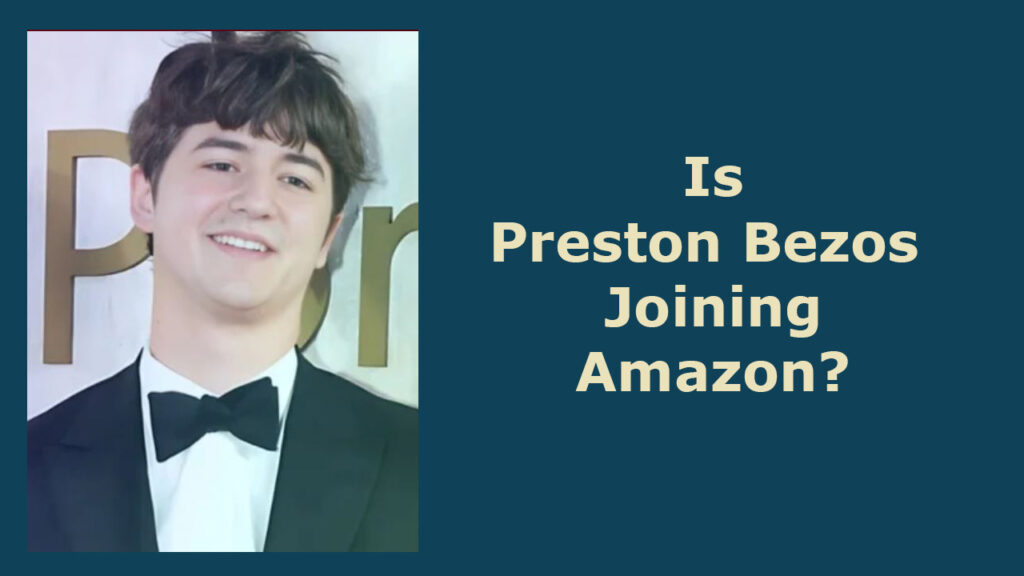
When the founder of Amazon built an empire, would his eldest son inherit a corner office—or carve his own path? For years, you’ve probably wondered about Preston Bezos, the rarely seen heir to one of the world’s greatest fortunes. While your social media feeds fill with celebrity gossip, Preston has remained almost entirely out of the spotlight. That silence has led to one burning question: Is he joining Amazon?
Here’s the thing: after digging into public records, examining corporate governance patterns, and analyzing what we actually know about Preston’s education and family dynamics, the answer is surprisingly clear. The likelihood of Preston Bezos joining Amazon is extremely low—probably in the 5-10% range. This article walks you through the evidence. We’ll examine Preston’s publicly known background, look at how billionaire heirs typically behave, investigate Amazon’s leadership culture, and show you exactly why the odds are stacked against a family member taking on a significant role at the company. By the end, you’ll understand not just what the data suggests, but why it matters for understanding how modern mega-corporations operate.
WHO IS PRESTON BEZOS?
If you’ve tried to find information about Preston Bezos online, you’ve probably hit a wall. That’s intentional. Here’s what we actually know, based on verified public sources.
Preston Bezos was born around 2000, making him currently around 25-26 years old. He’s the eldest child of Jeff Bezos and MacKenzie Scott, the philanthropist and novelist who was married to Jeff for 25 years before their 2019 divorce. His first name is Preston—actually his father’s middle name. That’s a family tradition: Jeff’s middle name came from his grandfather Lawrence Preston Gise and great-grandfather Lloyd Preston Gise, so naming his firstborn Preston carried real family significance.
Here’s what makes Preston different from other billionaire kids you might read about: your complete lack of information about him is by design. While billionaire children often show up on Instagram, at charity galas, or in paparazzi photos, Preston has almost no public digital footprint. Jeff Bezos famously keeps his children completely private. He doesn’t post photos of them on his social media (which mostly features Blue Origin rockets and his relationship with Lauren Sánchez). The names and ages of Preston’s three younger siblings remain entirely unknown to the public.
What you can find about Preston suggests he’s had a relatively normal wealthy childhood—at least by billionaire standards. His father has shared that he made a point to have breakfast with his kids before they went to school, despite running one of the world’s largest companies. And yes, Jeff taught his kids to use power tools and sharp knives at a young age to build “resourcefulness,” which sounds extreme until you remember his parenting philosophy values risk-taking and self-reliance. The few public appearances Preston has made—at the 2020 Oscars when Amazon’s film Les Misérables was nominated, and at the Smithsonian in 2019—show him as a quiet, reserved young man who clearly prefers being out of the camera’s way.
EDUCATION, EARLY INTERESTS, AND PUBLIC FOOTPRINT
This is where things get interesting. Preston’s educational path tells you something important about his values and interests.
For years, various outlets reported that Preston attended Princeton University, following in his father’s footsteps—Jeff graduated from Princeton in 1986 with a degree in engineering. But here’s the correction: Preston actually attended MIT, not Princeton. His name appears in MIT’s Class of 2022 commencement program, where he received a Bachelor of Science in Humanities and Engineering. Jeff Bezos was photographed at the MIT commencement ceremony in May 2022, seemingly attending his son’s graduation.
That degree choice—Humanities and Engineering—is genuinely revealing. It’s not a pure computer science degree, and it’s not a business school track. It’s a blend suggesting intellectual curiosity about both technical and human dimensions of problem-solving. In an era when tech billionaire heirs often pursue either hardcore CS degrees or business/finance tracks, Preston chose something different. This hints at someone thinking about technology’s relationship to society, not just how to maximize profit or code the next algorithm.
Beyond his MIT degree, your search for public statements from Preston, LinkedIn posts, or social media reveals almost nothing. Unlike some billionaire children who announce their startups on Twitter or post about their internships on Instagram, Preston maintains essentially zero public social media presence that we can verify. This isn’t unusual for someone raised in extreme privacy, but it does mean you have zero direct evidence about his professional aspirations or current projects.
The viral videos that circulated online in 2024-2025 allegedly showing Preston “breaking his silence” about his father turned out to be dramatized entertainment content, not verified news. These videos make dramatic claims about family tensions, but they provide no credible evidence and should be treated as speculation masquerading as journalism.
FAMILY BUSINESS PATTERNS: DO BILLIONAIRE HEIRS JOIN THE EMPIRE?
To answer whether Preston will join Amazon, you need to understand a bigger pattern: what do the children of billionaires actually do?
The answer is more surprising than you might think. Recent data shows that inherited wealth is exploding among the ultra-rich—for the first time in 2025, the amount of wealth transferred to heirs exceeded wealth created by new entrepreneurs. But here’s the catch: most billionaire heirs don’t join the family business. In fact, they’re increasingly pursuing independent paths.
Let’s look at some real examples:
Heirs who did join family businesses: At Reliance Industries (India’s largest conglomerate), Mukesh Ambani’s three children joined the board in 2023—Akash now leads Jio’s telecom division, Isha oversees retail, and Anant focuses on energy. At Walmart, the Walton heirs served long tenures on the board and as chairman, though each took different roles based on their interests and abilities. Giovanni Ferrero leads his family’s confectionery empire as executive chairman.
But here’s the more interesting trend—heirs pursuing independent paths: Parth Jindal, son of Indian steel magnate Sajjan Jindal, founded his own venture capital fund at age 23 to invest in tech startups rather than join the family steel business. Rishabh Mariwala chose to lead his mother’s startup (Soap Opera, a premium handmade soap brand) instead of joining his father’s massive consumer goods company. Anand Piramal launched his own real estate business after studying what the “next $5 billion opportunity” could be for his family.
Why the difference? Corporate governance standards have gotten much stricter. Today, boards of directors and shareholders scrutinize family hiring decisions far more carefully than they did 30 years ago. When a billionaire tries to promote a family member without relevant experience, institutional investors, proxy advisory firms, and media criticism follow quickly. Your typical Fortune 500 board now requires documented qualifications, external vetting, and sometimes even independent committees to approve family promotions.
Additionally, modern billionaires themselves have shifted their thinking. According to UBS research, 82% of surveyed billionaires with children want them to succeed independently and develop their own skills, rather than rely solely on inherited wealth—even though 43% still hope their children will eventually grow the family business. It’s a fascinating contradiction: parents want their kids to have their own accomplishments and to take over the empire.
AMAZON’S CULTURE, GOVERNANCE, AND PRECEDENT
Now let’s look specifically at Amazon. Here’s what you need to understand about how the company is structured and how Jeff Bezos approaches succession.
Amazon has zero family members in executive leadership. None. Your look at the company’s S-team (the 28 senior executives who run the company) shows professional managers, not Bezos family members. The board of directors includes Jeff Bezos as Executive Chairman, but the remaining 11 board members are external directors, venture capitalists, and corporate leaders—not family. This is completely different from, say, News Corp (where multiple Murdochs hold executive positions) or Mars Inc. (where family members have served as co-presidents).
When Jeff Bezos stepped down as CEO in July 2021, he didn’t hand the job to a family member. He handed it to Andy Jassy, an external executive who’d been with Amazon since 1997 and built the AWS division into a $40+ billion annual revenue machine. Jassy was Bezos’s professional protégé, not his son. This choice sent a clear signal: Bezos values professional merit over family ties, even for the most powerful job at his company.
What’s remarkable is how deliberately Bezos structured this. Amazon has detailed governance committees including the Leadership Development and Compensation Committee, which oversees succession planning. The Nominating and Corporate Governance Committee ensures independent directors evaluate leadership candidates. These aren’t ceremonial bodies—they’re actively involved in major decisions. If Preston were being groomed for a role at Amazon, your would expect to see at least some signal: board committee assignments, executive mentorship relationships, or strategic roles. Instead, there’s complete silence.
Moreover, your examination of Bezos’s post-CEO focus tells you everything about his priorities. Since 2021, he’s thrown his energy into:
-
Blue Origin (space exploration and eventual human spaceflight)
-
The Bezos Earth Fund ($10 billion commitment to climate and nature solutions)
-
The Day One Fund (homeless services and early childhood education)
-
Bezos Expeditions (family office managing $107.8 billion in assets)
Nowhere in this list is “grooming a successor in the family” or “preparing Preston for Amazon leadership.” If Bezos cared about family succession at Amazon, you’d expect him to stay more involved in CEO selection, mentor his son toward a C-suite role, or at least arrange board exposure. Instead, he’s moved on.
POSITIVE SIGNALS FOR—AND AGAINST—PRESTON JOINING AMAZON
Let’s be intellectually honest. If you were trying to build a case that Preston will join Amazon, what evidence would you cite?
Potential positive signals (weak, but real):
-
He has a technical education (Bachelor of Science in Humanities and Engineering from MIT)
-
His father emphasized entrepreneurial values and risk-taking from childhood
-
The family office (Bezos Expeditions) exists and has significant capital
-
His father named him after a family legacy (Preston)
-
Preston attended his father’s important events, suggesting family closeness
That’s about it. And honestly, none of these are strong signals. An engineering degree from MIT doesn’t mean you want to work at your father’s company. Entrepreneurial upbringing could just as easily lead to starting your own venture. Family offices exist primarily to manage wealth, not to launch children into their founders’ businesses.
Now, the much longer list of negative signals:
-
Complete absence from professional life: No LinkedIn profile, no public statements, no business ventures announced, no internships at Amazon that you can find. Contrast this with other billionaire heirs (like Jamie Xie, daughter of Fortinet founder Ken Xie) who actively build public careers. Preston’s silence is deafening.
-
Jeff’s succession choices: By selecting Andy Jassy, Jeff explicitly chose an external professional over family. This isn’t ambiguous. It’s a statement about his values regarding corporate leadership.
-
Amazon’s governance structure: The company has built robust independent boards and committees specifically designed to prevent nepotism concerns. If Preston applied for a job at Amazon tomorrow, he’d face the exact same external evaluation process as anyone else—maybe more scrutiny. Shareholders would revolt at the optics of a founder’s son taking a preferential path.
-
Preston’s education suggests other interests: A Humanities and Engineering degree isn’t the typical path for someone planning to become a logistics executive or engineering manager at Amazon. It’s broader, more philosophical.
-
MacKenzie Scott’s influence: Your examination of Preston’s upbringing reveals that while Jeff built Amazon, MacKenzie Scott raised the children. Scott is now a major philanthropist focused on education, early childhood development, and social justice—not on building business dynasties. If she’s had significant influence on Preston’s values, he likely inherited her focus on impact and independence rather than corporate power.
-
Trends among wealthy heirs: The data shows young billionaire heirs increasingly prefer independent ventures, family office management, or philanthropic work over joining founder-led businesses. Preston, born around 2000, would be part of this generation.
-
Privacy preference: Everything about Preston—or rather, the lack of information—suggests he values privacy over public attention. Taking a high-profile role at Amazon would destroy that. If he wanted visibility and power within his father’s company, wouldn’t you expect some public preparation for it?
THREE REALISTIC SCENARIOS IF PRESTON JOINED AMAZON
Just for the sake of analysis, let’s imagine Preston did decide to join Amazon. What role might he take? How would it work?
Scenario A: Technical / Engineering Role
In this scenario, Preston leverages his MIT engineering degree and joins Amazon as a product manager, software engineer, or technical leader in one of Amazon’s divisions—perhaps AWS, Devices, or Robotics.
Pathway: Start as a junior PM or engineer (probably around 2022-2023), spend 3-4 years building credibility, potentially move into a senior technical role by his early 30s.
Timeline: 5-10 years to reach middle management; possibly 15+ years to reach executive level.
Constraints: This would be heavily scrutinized. Every promotion would be questioned. He’d need to genuinely outperform peers to avoid optics of favoritism. The S-team would likely view this as a governance risk unless Preston proved exceptional capability. Any failure would be weaponized by critics as proof of nepotism. The burden of proof would be entirely on him.
Scenario B: Corporate / Leadership Track
Preston pursues an MBA (which he hasn’t publicly done), then enters Amazon through a rotational leadership program, eventually climbing toward senior management.
Pathway: Get an MBA from a top program, enter as a manager in one of Amazon’s divisions, move through increasingly senior roles.
Timeline: MBA (2 years) + corporate climb (7-10 years minimum to reach executive tier).
Constraints: This path is used by talented external hires all the time, but for a founder’s son, it would invite criticism that he’s getting an accelerated track. Amazon’s meritocratic culture would be tested. The optics are terrible—it looks like nepotism even if he’s genuinely qualified. Board and shareholder confidence would be fragile.
Scenario C: External Partner / Investor / Advisor
Instead of joining Amazon as an employee, Preston becomes an advisor, board member of a subsidiary, or strategic investor through Bezos Expeditions. In this case, he’d contribute to Amazon’s ecosystem without being an executive.
Pathway: Launch his own venture or investment focus that complements Amazon’s strategy; eventually serve on a board or advise on specific initiatives (perhaps space technology, climate solutions, or emerging markets).
Timeline: Flexible; could happen immediately or over many years.
Constraints: He’d need actual business credentials—a successful startup, investment track record, or demonstrated expertise. He can’t just be given a seat on the board because he’s Jeff’s son. Corporate governance wouldn’t allow it without justification.
The honest verdict on all three scenarios: Each would face serious skepticism. Amazon has deliberately built a culture and governance structure that discourages family succession. A Bezos family member taking a major role would undermine the meritocratic image the company projects and invite shareholder litigation.
EXPERT VIEW: GOVERNANCE, OPTICS, AND LIKELY OUTCOMES
What do corporate governance experts actually say about founder families joining large public companies?
The research is pretty clear: nepotism in publicly traded companies erodes shareholder value and leadership credibility. Firms with high concentrations of family members in executive roles show lower investment in growth, less sensitivity to market opportunities, and higher conflict of interest concerns. When a public company promotes a family member, institutional investors often view it as a red flag. If boards aren’t careful, it can trigger shareholder lawsuits.
The standards for family governance have become quite sophisticated. Some leading family businesses now require that family members work outside the business for at least three years before joining, must be sponsored by non-family mentors upon entry, must start in entry-level roles appropriate to their qualifications, and all promotion decisions must be approved by independent committees comprised of non-family members.
Amazon hasn’t explicitly stated such policies, but the company’s track record—zero family members in executive leadership, independent board governance, professional succession—suggests the leadership views family succession as a liability, not an asset.
Additionally, consider Jeff Bezos’s own trajectory. He didn’t inherit Amazon; he built it from a garage. His entire identity is wrapped up in self-made entrepreneurship and risk-taking. That same identity likely influences how he thinks about his children. He may genuinely not want them to inherit corporate roles—he may want them to forge their own paths and earn their own credibility, much as he did.
PRESTON BEZOS TIMELINE
-
~2000: Born in Seattle area
-
2001-2018: Raised largely out of public view; mother MacKenzie Scott primary caregiver while Jeff built Amazon
-
2018: Helps father move into college dorm (mentioned in Jeff’s public speech)
-
2019: Attends Smithsonian Gala with father; parents announce divorce
-
2020: Photographed at Academy Awards with father when Amazon’s Les Misérables nominated
-
2020-2022: Attends MIT; pursues Bachelor of Science in Humanities and Engineering
-
May 2022: Graduates from MIT; Jeff photographed at commencement
-
2022-2026: Maintains essentially zero public profile
-
2024-2025: Various unverified “Preston speaks out” videos circulate online; treated as entertainment speculation, not news
FAQs
Is Preston the heir to Jeff Bezos’s fortune?
Not necessarily in the way you might think. Jeff and MacKenzie Scott didn’t publicly announce how they’d divide their wealth. Legally, Preston likely benefits from trusts and family structures, but there’s no public information about specific inheritance amounts. MacKenzie Scott has committed to giving away at least half her wealth to charity, so Preston’s inheritance depends on whatever portion she retains. Jeff’s wealth is largely tied up in Amazon shares and other investments managed through Bezos Expeditions.
Why is Preston so private?
Jeff Bezos prioritizes his children’s privacy as a core value. He doesn’t post photos of them on social media and actively works to keep them out of the public eye. This likely stems from his own experience building a public company and wanting his kids to have normal childhoods away from media scrutiny.
Could Preston join Amazon in the future even if he doesn’t now?
Yes, theoretically. But he’d face significant barriers and scrutiny. If he eventually did join, you’d expect him to first build credentials elsewhere—a successful startup, investment track record, or demonstrated expertise—to justify the hire on merit rather than family connection.