
Last updated on: June 26, 2026
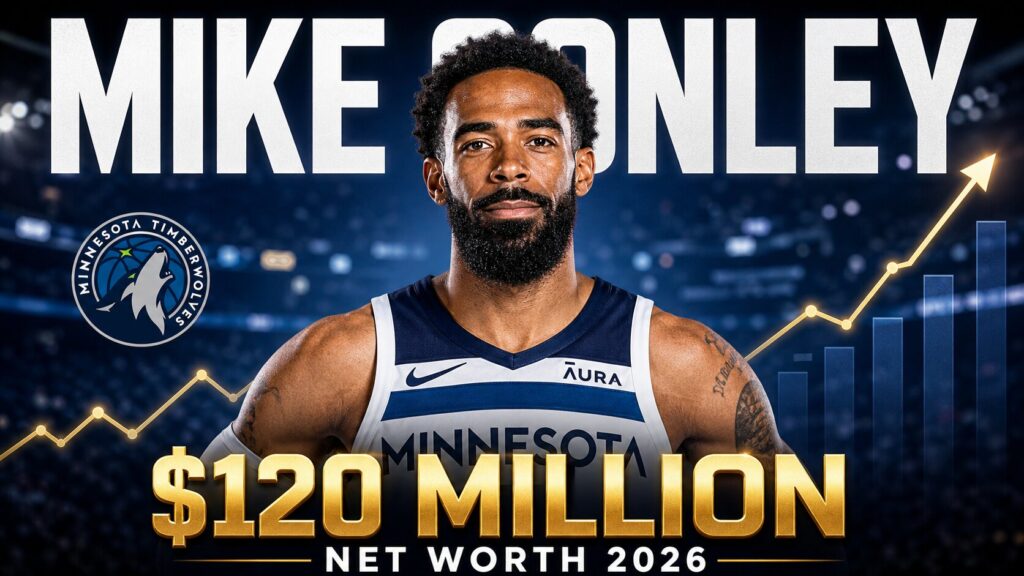
Mike Conley has never been the flashiest name in the league. He doesn’t dominate highlight reels or chase headlines. Yet as of 2026, the 38-year-old point guard sits on an estimated net worth between $70 million and $120 million, with career NBA earnings pushing $295 million.
That number didn’t come from one massive payday or a shoe empire. It came from 19 seasons of showing up, staying healthy enough to play, making smart decisions with the ball and with his contract negotiations, and treating basketball like a long-term profession rather than a sprint. In an era where many players chase the next big thing, Conley’s story is a masterclass in steady accumulation.
Early Life and the Foundation of Discipline
Born Michael Alexander Conley Jr. on October 11, 1987, in Fayetteville, Arkansas, and raised in Indianapolis, Conley grew up in an athletic household that valued excellence without the noise. His father, Mike Conley Sr., won Olympic gold and silver in the triple jump. His uncle Steve Conley played linebacker in the NFL. Expectations were high, but so was the example of disciplined, focused work.
At Lawrence North High School, Conley won three state titles alongside future No. 1 pick Greg Oden. One season at Ohio State followed — he averaged 11.3 points and led the Big Ten in assists — before the Memphis Grizzlies selected him fourth overall in the 2007 draft. From day one, the kid carried himself like a veteran. That maturity would later translate directly into financial longevity.
The $295 Million Paycheck: Year-by-Year Reality
Let’s talk real numbers. According to Spotrac tracking, Conley has now cleared $295,168,909 in NBA salary through the 2025-26 season.
Here’s how it actually built up:
| Period | Team(s) | Key Earnings Context | Cumulative (approx.) |
|---|---|---|---|
| 2007–2010 | Memphis | Rookie scale + first extension | ~$15.8M |
| 2011–2015 | Memphis | 5-year, $40M extension | ~$55.5M |
| 2016–2019 | Memphis | Historic 5-year, $152.6M max deal | ~$171.6M |
| 2019–2021 | Utah | High-salary years post-trade | ~$227M |
| 2021–2023 | Utah → Minnesota | 3-year, $68M extension + trade | ~$274M |
| 2023–2026 | Minnesota (with 2026 drama) | Veteran extension + minimum deal | $295.17M |
The jump in 2016 stands out. That summer, after the salary cap exploded, Conley signed a five-year, $152.6 million deal with Memphis — the richest contract in NBA history at the time. Average annual value around $30.5 million. For context, that was bigger than what many true superstars were making just a couple years earlier.
He didn’t waste it. He kept playing at a high level, avoided major off-court issues, and when the time came to move on from Memphis in 2019, he landed in Utah and later Minnesota with contracts that continued to pay well while giving teams flexibility.
Even in 2026, after a strange sequence of trades (Minnesota → Chicago → Charlotte, then waived and quickly re-signed by the Timberwolves on a minimum deal), he still added to the total. That’s the Conley way — he finds a way to keep contributing and keep earning.
The Contracts That Actually Mattered
Not every deal was a max. The smart ones were the ones that matched his value and the team’s needs at the time.
- 2010/2011 extension (5 years, $40M): Locked him in during his prime years in Memphis when the team was building something real.
- 2016 max (5 years, $152.6M): The one that changed his financial life forever. It came right as the league’s new TV deal money hit the cap. Timing was everything.
- 2021 Utah extension (3 years, ~$68M): Gave him security after the trade from Memphis and helped Utah stay competitive.
- 2024 Minnesota extension (2 years, $20.75M): A veteran-friendly deal that kept him in a winning environment with younger stars around him.
- 2026 minimum: Short-term money, but it kept him on a roster and added another chapter.
What’s impressive isn’t just the big numbers — it’s how few mistakes there were. No holdouts, no public contract drama, no bridges burned. Agents and front offices knew Conley was low-risk, high-character, and would show up ready. That reputation has real dollar value over a long career.
Endorsements and the “Other” Money
Conley has never been a massive endorsement machine like some of his peers. Peak endorsement income hovered around $1 million per year in his best seasons, according to Forbes.
Early deals with Adidas gave way to Under Armour, then Converse/Jordan Brand. He’s also had partnerships with Toyota and Vivint Smart Home. Nothing flashy, nothing controversial — just steady, respectable brand alignment that fits his low-key personality.
He’s also dipped into producing (notably the short film Two Distant Strangers), which shows he’s thinking beyond the court. These side ventures don’t move the needle like his salary, but they add up and keep his name in different rooms.
Assets, Lifestyle, and How the Money Is Actually Used
Conley has never been one for ostentatious displays. Reports mention a modest but nice car collection — a Maserati Quattroporte, Range Rover, Tesla Model S, and a Ford Bronco. Practical luxury, not supercar excess.
Real estate moves have been similarly grounded. During his long Memphis tenure he bought and eventually sold a home there (classic player real estate story — bought for around $900k, sold years later). Like many veteran players, he’s likely built equity in properties in the cities he’s called home.
The bigger picture on lifestyle is family. He married Mary Peluso (whom he met at Ohio State) in 2014. They have three sons. He’s spoken openly about his Christian faith and keeping life centered. In a league full of distractions, that stability probably saved him millions in bad decisions or unnecessary spending.
He’s also consistently been one of the NBA’s best citizens — multiple Sportsmanship Awards, the longest streak without a technical foul in league history (over 34,000 minutes), and regular community work. That reputation doesn’t directly pay the bills, but it opens doors and protects the brand long-term.
Putting the Net Worth Together
So how do we land on that $70–120 million range?
Start with $295 million in on-court earnings. Subtract taxes (which in high-tax states and with proper planning still leave a big chunk), agent fees, and living expenses. Add endorsement income over nearly two decades (likely $10–20 million cumulative). Factor in asset appreciation — real estate, investments, and whatever else a smart financial team has done with the money.
Celebrity Net Worth currently lists him at $120 million (updated late 2025). Other outlets have used lower figures around $70 million. Both can be right depending on how much illiquid wealth (property, investments, future earnings) you include. The truth is probably somewhere in the middle to upper end of that range — and still growing modestly.
What stands out is how little drama or waste there’s been. No massive public splurges, no messy divorces, no business ventures gone wrong that we know of. The money has largely stayed protected.
What Comes Next
At 38, Conley is in the final phase of his playing career. He’s still valuable as a steady veteran presence, especially on a competitive Timberwolves team. Even if he plays just one or two more seasons at reduced numbers, every additional million adds to the total and the legacy.
After basketball, the foundation is already there for whatever comes next — whether that’s front-office work, broadcasting, business investments, or simply enjoying family life with significant financial freedom. Players who last this long and manage this well rarely struggle post-career.
Conley’s net worth isn’t flashy. It’s not built on one viral moment or a signature shoe. It’s built on nearly two decades of being exactly who he said he was: a professional who shows up, plays the right way, takes care of his body and his business, and lets the compound effect of consistency do the heavy lifting.
In today’s NBA, where careers can feel shorter and noisier than ever, that might be the rarest and most valuable skill of all.