
Last updated on: February 12, 2026
On February 11, 2026, James Van Der Beek — the soulful face of Dawson Leery from Dawson’s Creek and the underdog quarterback from Varsity Blues — died at 48 after a long, public fight with stage 3 colorectal cancer.
His wife, Kimberly, shared the news in a simple, aching Instagram statement:
“Our beloved James David Van Der Beek passed peacefully this morning. He met his final days with courage, faith, and grace… There is much to share regarding his wishes, love for humanity and the sacredness of time. Those days will come. For now we ask for peaceful privacy as we grieve our loving husband, father, son, brother, and friend.”
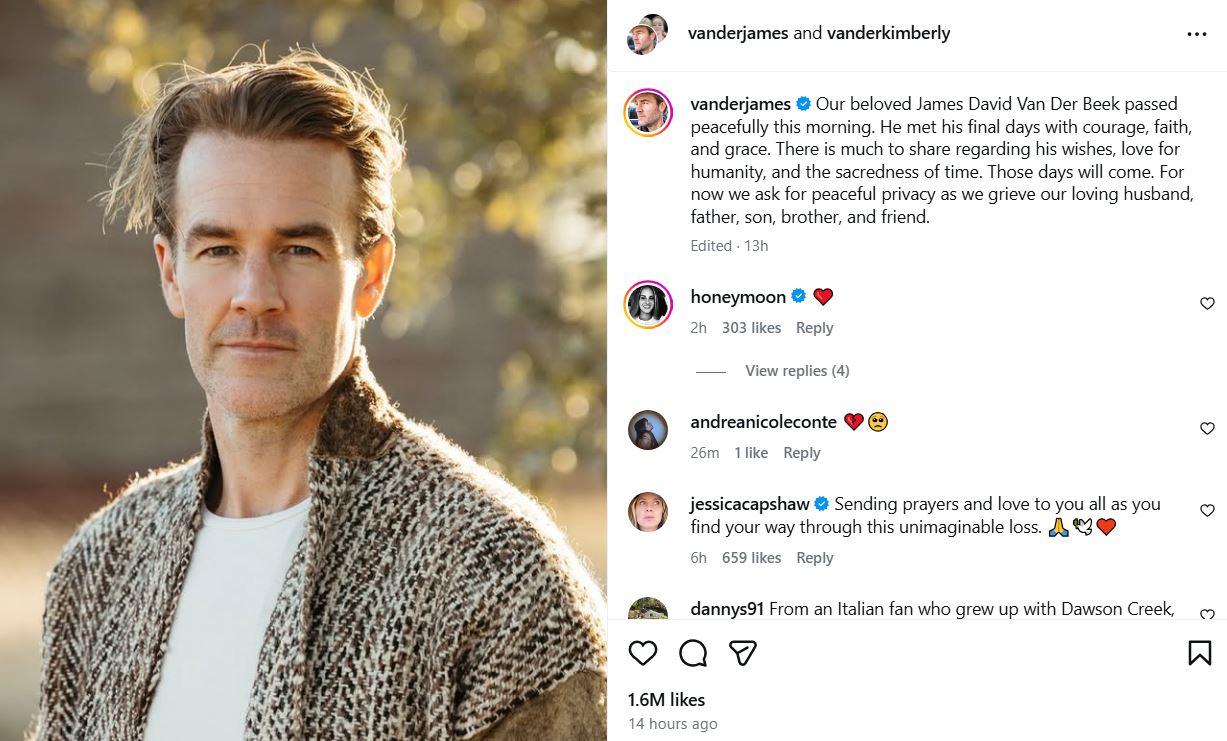
If you grew up in the late ’90s or early 2000s, you probably saw yourself in James at some point — in his awkwardness, his big feelings, his belief that love and art mattered. As he got older, he became something more: a devoted dad on a Texas ranch, a husband who never stopped praising his wife, and a man willing to use his own cancer story to push you to get screened and to believe you are worthy of love, exactly as you are.
Announcement of Death and Immediate Context
James died on the morning of February 11, 2026, at his home near Austin (Spicewood), Texas, from complications of stage 3 colorectal cancer. He had been diagnosed in August 2023 after a colonoscopy and chose to share the news publicly in November 2024, hoping his story would push more people — especially younger adults — to take screening seriously.
He was 48 years old. He leaves behind his wife, Kimberly, and their six children — Olivia, Joshua, Annabel, Emilia, Gwendolyn, and Jeremiah — the family he often called the center and “beautiful chaos” of his life.
In that first statement about his death, the family asked you and the rest of the world for “peaceful privacy” as they grieve. The public knew he was sick, but the finality still felt sudden; only weeks earlier, he had been giving interviews, talking about cancer as a “gift” that forced him to slow down and to learn self‑love.
Early Life and Rise to Fame
James David Van Der Beek was born March 8, 1977, in Cheshire, Connecticut, the oldest of three children. His mother, Melinda, was a dancer and gymnastics teacher; his father, James William, worked for a phone company. His Dutch last name — “Van Der Beek” — literally means “from the creek,” a small detail that later felt like destiny when he became the face of Dawson’s Creek.
He attended Cheshire Academy, a private boarding school, where a concussion ended his football hopes and pushed him toward acting. By his mid‑teens he was doing New York theater and small film roles, including Angus (1995) and I Love You, I Love You Not (1996). In 1995 he enrolled at Drew University in New Jersey on an academic scholarship, studying English and sociology and singing in an a cappella group — but his life changed when he landed a pilot for a new teen drama on The WB.
In 1997, James won the lead role of Dawson Leery, a film‑obsessed, tender‑hearted teenager from the fictional town of Capeside. When Dawson’s Creek premiered in 1998, it became a defining show for a generation and a cornerstone for The WB. For five seasons, James’ open, often tearful performance made “the sensitive boy next door” into a new kind of teen heartthrob.
At the same time, he broke into film. In Varsity Blues (1999), he played backup quarterback Mox, a kid who loved books more than football and challenged a toxic coach and town culture. The movie topped the U.S. box office and cemented his status as a major young star. He followed it with projects like Texas Rangers (2001) and the dark campus satire The Rules of Attraction (2002), and he happily poked fun at his own image in comedies like Scary Movie and Jay and Silent Bob Strike Back.
Career Evolution and Later Roles
After Dawson’s Creek ended in 2003, James stepped out of the teen idol box and rebuilt his career piece by piece. He took guest roles on shows like How I Met Your Mother, Ugly Betty, Criminal Minds, and One Tree Hill, showing that he could play smug villains, sad clowns, and regular guys with equal ease.
He took on more serious TV work, including the NBC medical drama Mercy, where he played Dr. Joe Briggs, the intense chief of the ICU, and later CSI: Cyber on CBS, opposite Patricia Arquette. He also starred in the short‑lived but beloved 2014 sitcom Friends with Better Lives, playing Will, a newly single gynecologist trying to figure out adult life alongside his equally messy friends.
One of his smartest moves was to lean into his own fame. In Don’t Trust the B—- in Apartment 23, James played a heightened, arrogant version of “James Van Der Beek,” gleefully sending up his Dawson image and that famous crying GIF. It showed you he was in on the joke and not afraid to play with his past.
He also worked with Ryan Murphy on Pose, playing a Wall Street boss in a series that broke ground with its focus on LGBTQ ballroom culture in 1980s New York. And in the 2010s and 2020s, he kept up a steady mix of film roles (like Labor Day and indie projects), TV guest spots, and family‑friendly movies such as the Sidelined films and other streaming originals.
In 2019, he joined Season 28 of Dancing with the Stars, partnered with pro Emma Slater. Despite no formal dance training, he became a frontrunner, earning perfect scores and finishing in the semifinals. Fellow contestants and viewers saw a familiar pattern: total commitment, vulnerability, and a willingness to talk openly about personal pain — including a family miscarriage — while still showing up on stage.
At the same time, James became more outspoken off‑screen. During the early #MeToo wave, he revealed that, as a young actor, “older, powerful men” had groped him and cornered him in sexual conversations, and he used his own story to defend people who were asked why they hadn’t spoken up sooner. He didn’t present himself as a hero; instead, he tried to show you how shame and power imbalances silence survivors of all genders.
In later years, his focus shifted more toward family, independent projects, and using his platform with care. He moved with his family from Los Angeles to a ranch outside Austin, Texas, and began speaking more about slowing down, nature, parenting, and what real success meant to him.
Cancer Diagnosis and Brave Public Journey
The story that finally defined the last chapter of his life began quietly in 2023. James noticed subtle changes in his bowel movements — nothing dramatic, just enough that, after trying to blame coffee and diet, he finally listened to his body. A colonoscopy in August 2023 revealed stage 3 colorectal cancer.
He kept the diagnosis private for over a year while going through surgery and chemotherapy. In November 2024, he told People and TODAY that he was living with stage 3 colorectal cancer, diagnosed at age 46, and that he had been in “amazing cardiovascular shape” with no family history. He wanted you to know one thing: you can “do everything right” and still get this disease.
From then on, he chose radical honesty. In interviews with TODAY, USA TODAY, Healthline, and others, he talked about:
-
How cancer forced him to slow down and question every part of his life
-
The shock of being away from his kids and unable to function as the strong, hands‑on dad and provider he believed he had to be
-
The way treatment stripped away his roles until he was “just a too‑skinny guy alone in a room with cancer” — and how meditation led him to the belief that he was still “worthy of love… simply because I exist.”
He went so far as to call his diagnosis “the best thing that’s ever happened to me” — not because the illness was good, but because it forced life‑changing clarity. Cancer became, in his words, a “gift” that taught him presence:
“So presence is really the gift that cancer’s given me.”
He also turned his journey into action. James partnered with Guardant Health as the first ambassador for its FDA‑approved Shield blood test for colorectal cancer screening, telling adults 45+ that a simple blood draw could be the nudge they needed to get checked. He repeated a simple message to you over and over: if you’re 45 or older — or younger with symptoms — talk to your doctor and get screened.
But behind the inspiring words, the struggle was brutal. The treatments were long and expensive. In late 2025 he auctioned off personal Dawson’s Creek and Varsity Blues memorabilia, raising over $47,000 to pay for chemotherapy and scans. Friends later launched a GoFundMe to help his family, noting that months of treatment had left them “out of funds” and at risk of losing their home.
Physically, he lost weight, strength, and the ability to attend events. He had to withdraw from a highly anticipated Dawson’s Creek charity reunion in 2025, sending a video message instead while Lin‑Manuel Miranda read Dawson’s lines on his behalf. Emotionally, he spoke about nights of despair, but also about an inner voice that told him this suffering could still add “healthy, happy years” to his life — if not in length, then in depth.
In the end, his advocacy resonated widely. Cancer organizations, doctors, and patient groups pointed to his story when talking about the sharp rise in colorectal cancer among younger adults and the need for earlier, easier screening. If his journey nudges you to book a colonoscopy or ask about a blood‑based test, that is part of the legacy he was fighting for.
Personal Life and Family
For all the roles and the headlines, James’ proudest identity was simple: husband and dad.
He met producer Kimberly Brook in 2009; they married in 2010 and welcomed six children over the next decade. In interviews, he often spoke about how fatherhood rearranged his priorities. Fame and career, he said, were nothing compared with reading bedtime stories, cooking on their land, and watching his kids run barefoot across the fields.
In 2020, the family left Beverly Hills for a 30‑plus‑acre ranch near Austin. Kimberly, “a farm girl at heart,” said she longed for trees and skies; James called the move “centering” and said he felt “really looked out for” in Texas. Their kids learned to watch moon phases, welcome the rain, and live close to the land. James liked that their education there was something he could never have given them in a classroom.
When cancer hit, that ranch became both refuge and reminder of what was at stake. In his final TODAY interview from the property, he said plainly, “I would not be alive if it weren’t for my wife,” praising Kimberly for stepping up as caretaker, nurse, and head of the household.
His spiritual life deepened as well. In talks and social posts near the end, he spoke often about “God’s love” and the belief that every person — including you — is worthy of love before you ever achieve or perform anything. That same spirit runs through Kimberly’s line about his “love for humanity and the sacredness of time.”
To many fans, this was the true arc of James’ story: the boy from Dawson’s Creek who once feared mobs of screaming teenagers growing into a man who found peace in dirt under his nails, kids in his arms, and a slower, more grounded life.
Tributes and Legacy
As news of his death spread, tributes poured in from across Hollywood and from millions of fans who had grown up with him.
Busy Philipps, who joined Dawson’s Creek in later seasons and stayed close with James, called him “one in a billion” and said he would “be forever missed,” urging people to support the GoFundMe for his family. She wrote that her heart ached especially for Kimberly and their six children.
Katie Holmes, his longtime on‑screen partner as Joey Potter, shared a handwritten note on Instagram:
“James, thank you. To share space with your imagination is sacred — breathing the same air in the land of make believe and trusting that each others’ hearts are safe in their expression… Bravery. Compassion. Selflessness… creating a beautiful marriage, six loving children — the journey of a hero.”
Sarah Michelle Gellar, Chad Michael Murray, Julie Plec, and many others called him a “generational icon” and “one of the good ones,” mourning not just the loss of an actor but of a kind, steady presence who showed up for colleagues, charities, and friends. Castmates from Dawson’s Creek spoke about his “heart” and his willingness to shoulder the weight of being the show’s face during a time when teen TV was still finding its voice.
The official Dawson’s Creek and studio accounts remembered him as the performance that “helped define a generation of television.” Many pointed out how his portrayal of a sensitive, emotional teenage boy opened space for a different kind of masculinity on screen — one where crying was not weakness, but honesty.
Fans responded in kind. Online, hashtags like #VanDerBeekStrong, which had grown during his treatment and memorabilia auction, shifted into memorials and stories: people sharing how Dawson kept them company through lonely high‑school nights, how Mox in Varsity Blues made them feel seen as kids who didn’t fit the mold, how his cancer interviews finally pushed them, or their parents, into a screening appointment.
Support for his family was immediate and overwhelming. The GoFundMe launched by friends quickly passed its original $250,000 goal and then crossed $1 million within a day, as tens of thousands of people donated whatever they could to help Kimberly and the children stay in their home and keep some stability. For someone who had worried out loud about being unable to provide, that outpouring was its own answer: he had been giving people something for decades, and now they were giving back.
Beyond fandom and fundraising, his impact on cancer awareness is likely to last. Guardant Health and other medical organizations publicly honored him as a powerful voice who made younger adults think twice about “minor” symptoms and long‑put‑off colonoscopies. Doctors quoted his story when explaining why colorectal cancer is rising so sharply among people under 50 — and why you can’t assume youth and fitness will protect you.
Final Reflection
When you step back from all the headlines, James Van Der Beek’s life looks less like a straight Hollywood success story and more like a very human journey.
He started as the kid from Connecticut who became a sudden teen icon. He wrestled with fame, burn‑out, and the darker corners of the industry. He rebuilt a career on his own terms, learned to laugh at his image, and chose projects that interested him rather than just kept him visible. Then he walked away from the center of the business to build a family and a slower life in Texas.
And when cancer arrived — without warning and without mercy — he did something rare: he let you in. He showed you the fear, the exhaustion, the money problems, the weight loss. But he also showed you what it looks like to keep choosing gratitude, to re‑learn your worth, and to fight not just for yourself but for strangers who might catch their cancer a little earlier because of your story.
If you take anything from James’ final years, let it be this:
-
Your body’s whispers matter. Changes in your bathroom habits, unexplained fatigue, blood in your stool — these are reasons to see a doctor, not to be polite and wait.
-
Screening saves lives. If you are 45 or older, or younger with risk factors or symptoms, talk to your doctor about colorectal cancer screening options, whether that’s colonoscopy or a blood‑based test.
-
You are worthy of love before you do or prove anything. As James himself learned, your worth is not in how much you provide, how productive you are, or how “strong” you seem. It is in the simple fact that you exist.
From Dawson’s bedroom window to a Texas field under a wide sky, James Van Der Beek’s story is one of growth, courage, and, finally, surrender with grace. His work will keep streaming, his crying GIF will keep circulating, and his interviews about cancer and self‑love will keep nudging people to get help sooner and to treat themselves more gently.
For his family, the loss is beyond words. For you, if he was ever part of your life on screen, the best way to honor him may be simple: book that screening, tell someone you love them, and remember that, in his own words, being present in the small, beautiful moments is the real gift time can give.