
Last updated on: March 10, 2026
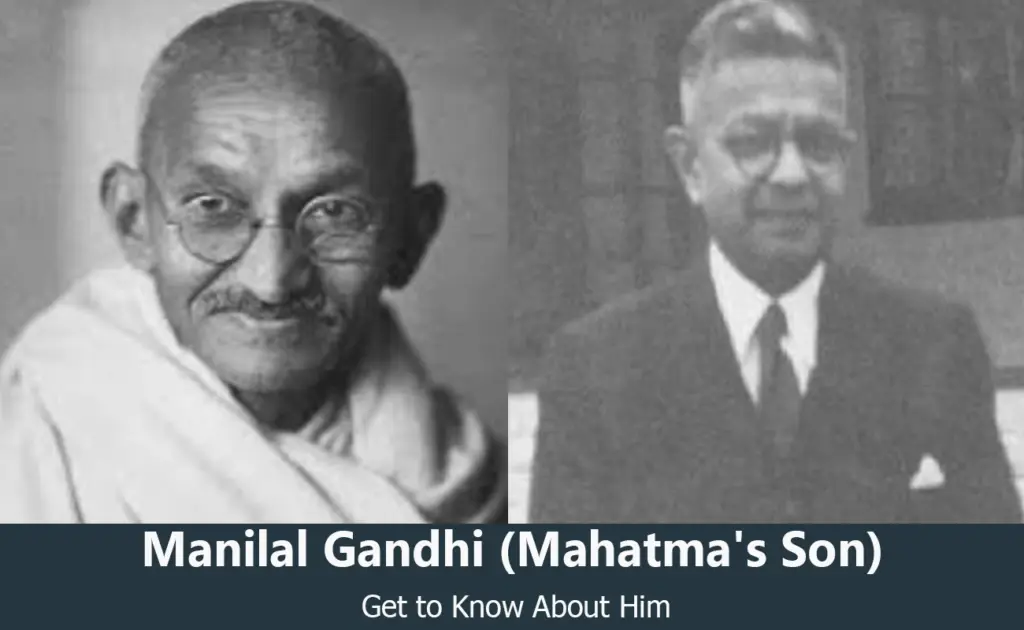
Manilal Gandhi was the second son of Mahatma Gandhi and Kasturba Gandhi. He is remembered as the son who stayed closest to his father’s ideas of truth, non-violence, and simple living. While Mahatma Gandhi led India’s freedom struggle, Manilal worked mainly in South Africa, where he spent most of his life fighting injustice through peaceful means.
He did not seek fame or power. Instead, he chose service, discipline, and hard work.
Quick Facts About Manilal Gandhi
| Full Name | Manilal Mohandas Gandhi |
| Birthdate | October 28, 1892 |
| Age | 63 years (at the time of death) |
| Birthplace | Rajkot, Gujarat, India |
| Occupation | Activist, Journalist, Newspaper Editor |
| Husband/Wife | Sushila Mashruwala (Married in 1927) |
| Education | Homeschooled at Phoenix Settlement and Tolstoy Farm (Gandhian education system) |
| Parents | Father – Mahatma Gandhi; Mother – Kasturba Gandhi |
| Siblings | Harilal Gandhi, Ramdas Gandhi, Devdas Gandhi |
| Children | Sita Dhupelia, Arun Manilal Gandhi, Ela Gandhi |
| Nationality | Indian (lived mainly in South Africa) |
| Famous For | Editor of Indian Opinion and promoter of non-violence in South Africa |
| Net Worth | <$1 million |
| Death Date | April 5, 1956 |
| Place of Death | Durban, South Africa |
Early Life and Childhood
Manilal Gandhi was born on October 28, 1892, in Rajkot, Gujarat. When he was still a child, his family moved to South Africa in 1897. This move shaped his entire life.
Unlike many children of his time, Manilal did not attend a regular school. His father believed education should build character, not just knowledge. So Manilal studied at community settlements such as Phoenix Settlement and Tolstoy Farm.
His daily routine included:
manual labour
farming work
printing press duties
prayer and self-discipline
This simple lifestyle taught him responsibility from a young age.
Life of Activism in South Africa
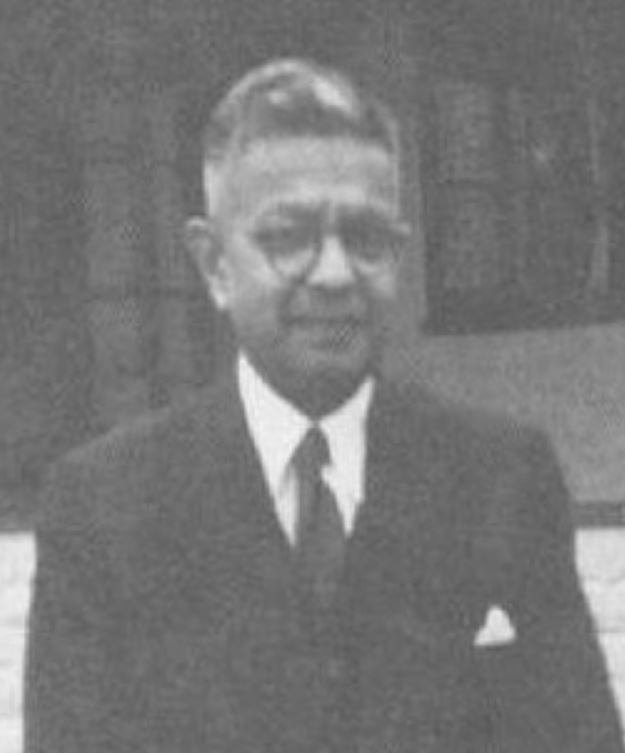
Manilal became involved in protests as a young man. He followed the path of satyagraha, or peaceful resistance.
In 1910, he was arrested in Johannesburg for selling goods without a license as part of a protest. During his prison stay, he demanded fair treatment for Indian prisoners. His efforts helped improve prison conditions, including separate water cups for Indian inmates.
In 1913, he led hunger strikes in prison to protest unfair treatment. These actions showed his courage and strong belief in non-violence.
From 1918 until his death, Manilal served as editor of Indian Opinion, the newspaper founded by his father. Through this paper, he spoke against racial discrimination and supported unity among communities. His work later earned respect from leaders such as Nelson Mandela, who admired Gandhian ideas.
Contributions in India
Although South Africa was his main base, Manilal also helped in India’s freedom movement.
Between 1914 and 1917, he assisted in building the Ahmedabad Ashram and learned how to make khadi, the hand-spun cloth promoted by Gandhi.
In 1930, he joined the famous Dandi Salt March as one of the 78 chosen volunteers. He was later jailed for ten months after participating in the Dharasana Salt Works protest. Even in difficult moments, he stayed committed to peaceful protest.
Personal Life and Family
Manilal lived a life guided by duty. He gave up higher education and even a personal marriage choice to follow his father’s wishes.
In 1927, he married Sushila Mashruwala. The couple lived simply and raised their children with strong moral values.
They had three children:
Sita Gandhi (later Sita Dhupelia)
Arun Manilal Gandhi, a writer and peace activist
Ela Gandhi, who later became an anti-apartheid leader and Member of Parliament in South Africa
Later Years and Death
Manilal returned to South Africa after his work in India and continued editing Indian Opinion. He remained active in social causes and community work throughout his life.
He passed away on April 5, 1956, in Durban, at the age of 63.
READ ALSO: Mahatma Gandhi Net worth, Age, Wife, Family, Facts & More
Legacy
Manilal Gandhi may not be as famous as his father, but his contribution was important. He carried Gandhian values beyond India and helped keep the spirit of non-violence alive in South Africa.
His life shows that change does not always come from loud voices. Sometimes it comes from steady work, quiet courage, and strong principles. Through journalism, activism, and simple living, Manilal proved that he was not only Mahatma Gandhi’s son — he was also a true follower of his ideals.