
Last updated on: June 15, 2026
When you think of Indian history, there’s one name that stands out as a symbol of courage, strategy, and vision—Chhatrapati Shivaji Maharaj. But here’s what most people don’t realize: Shivaji didn’t build the Maratha Empire alone. Behind his legacy was an entire family system, generations of warriors, queens, and administrators who shaped the destiny of India.
You’ve probably heard stories about Shivaji’s military genius or his administrative reforms. But what about the people who raised him? The women who stood by his side? The sons who inherited his dream? Understanding Shivaji’s family tree isn’t just about knowing names and dates—it’s about understanding how one family’s determination created an empire that challenged the mighty Mughal rule and kept India’s freedom alive.
The Bhosale Dynasty, which Shivaji belonged to, is one of India’s most remarkable royal families. Their journey from small nobles serving sultanates to becoming the founders of the Maratha Empire is nothing short of extraordinary. So let’s take you on a journey through the generations and help you understand how the Bhosale clan transformed Indian history.
Keywords: Maratha Empire, Bhosale Dynasty, Chhatrapati Shivaji Maharaj History, Maratha Family Tree, Swarajya
The Ancestry: The Roots That Run Deep
Before Shivaji became a legend, his family was already making waves in the Deccan. To truly understand Shivaji, you need to know where he came from—the ancestors who laid the foundation for his greatness.
The Legend of the Sisodia Link: When History Becomes Personal
Here’s an interesting fact that connects you, as an Indian, to royal heritage: Many historians believe that the Bhosale clan descended from the Sisodia Rajputs of Udaipur. Now, this isn’t just family gossip from centuries ago. When Shivaji was crowned as Chhatrapati in 1674, the legendary Brahmin scholar Gaga Bhatt officially formalized this connection to the Sisodias during the coronation ceremony. This was a big deal because it gave Shivaji the legitimacy he needed—the status of a Rajput king, not just a regional noble.
But here’s where historians differ. Some experts, like Dr. R.C. Dhere, suggest a different theory. They believe the Bhosales might have descended from the Hoysala Yadavas of Karnataka, making them part of an even older ruling dynasty. Whether it was the Sisodias or the Hoysalas, one thing is clear: the Bhosale family had royal blood flowing through their veins long before Shivaji’s time.
The Grandparents: When the Journey Began
Let’s go back a few generations. Your ancestors might have been servants or farmers, but the Bhosale family? They were already ambitious.
Babaji Bhosale (great-grandfather of Shivaji) was a Patil—a local administrator—in Devalgaon and Hingani Berdi. It wasn’t much, but it was a start. This is important because it shows you how empires don’t start with world domination. They start with families doing well in their local areas, gaining respect, and building connections.
Maloji Raje Bhosale (1552-1605)—now here’s where the story gets interesting. Maloji was the pioneer who took the family to the next level. Imagine being born in the 1550s, when the Deccan was ruled by powerful sultanates. Maloji didn’t fight them directly. Instead, he served them. He was a general and administrator in the Ahmadnagar Sultanate, which was one of the most powerful kingdoms of that time.
Maloji married Uma Bai (also known as Dipa Bai), who was the sister of Jagpalrao Nimbalkar, another noble family from the Deccan. This marriage was brilliant from a strategic perspective—it connected the Bhosales to another influential family. Together, Maloji and Uma Bai had two sons: Shahaji and Sharifji. The legacy would continue through Shahaji.
The Parents: The Diplomats and Mentors
Now we reach Shivaji’s direct parents—the two people who shaped his character and prepared him to be a great leader.
Shahaji Raje Bhosale (1594-1656) was a master diplomat and military commander. Think of him as a political chess player. Shahaji served multiple sultanates—the Ahmadnagar Sultanate, the Bijapur Sultanate, and even the Mughals. He was a man who understood power, loyalty, and when to shift alliances. He wasn’t a rebel like his son would become. Instead, he was practical. He built wealth, military experience, and connections that would later help Shivaji.
Shahaji married Rajmata Jijabai around 1615. If Shahaji was the strategist, Jijabai was the soul and conscience of the family. She was born around 1598, and her influence on Shivaji cannot be overstated. You know how you might have a mother or grandmother whose values shaped who you are? That was Jijabai for Shivaji.
Jijabai was more than just a wife to Shahaji. She was a visionary, a teacher, and a guardian of dharma (righteousness). While Shahaji was away serving different rulers, it was Jijabai who raised young Shivaji. She filled his mind with stories of Hindu glory, taught him about justice, and most importantly, she inspired him to dream of creating a kingdom where Hindus could rule themselves—a concept called “Swarajya” (self-rule).
When Shivaji was just a boy, Jijabai would tell him stories of the great Hindu kingdoms of the past. She taught him that loyalty to principles was more important than loyalty to any sultan. This is why many historians call her the real architect of the Maratha Empire. Without Jijabai’s influence, there might not have been a Shivaji we know today.
The relationship between Shahaji and Jijabai eventually became strained due to Shahaji’s political involvements and his second marriage to Tukabai (a Marathi noblewoman). But by then, Jijabai had already done her job—she had shaped a son who would change history.
Shivaji Maharaj’s Immediate Family: The Eight Wives and the Heirs
Now let’s talk about Shivaji himself and the family he created. You might be surprised to learn that Shivaji had eight wives. Before you judge this as unusual, understand the historical context: in 17th-century India, especially among royalty, marrying multiple women was a common political strategy. These weren’t just marriages for love (though there was love, especially with his first wife)—they were alliances. Through these marriages, Shivaji connected himself to powerful families, creating networks of loyalty and support across the Maratha territories.
The Eight Wives: Building Alliances Through Marriage
1. Saibai (1633-1659)—The First and Most Beloved
Saibai was Shivaji’s first wife, and she holds a special place in his heart and in history. She was the daughter of Laxmanrao Nimbalkar, a noble from the Nimbalkar family. Shivaji married her around 1651, and their bond was genuine. Unlike the other marriages that were primarily political, this one was filled with affection and partnership.
Saibai wasn’t just a wife sitting in the palace. She was involved in the kingdom’s affairs and was respected by the people. She bore Shivaji his eldest son, Sambhaji, who would become the second Chhatrapati. She also gave him three daughters: Sakhubai, Ranubai, and Ambikabai.
Tragically, Saibai died in 1659 at just 26 years old—likely due to childbirth complications. Shivaji was deeply affected by her death. In fact, when Saibai died, Shivaji’s sister-in-law, Parvatibai (Saibai’s younger sister), was already widowed. Shivaji then married Parvatibai to honor Saibai’s memory and to ensure that her sister and Saibai’s children were cared for. That’s how much Saibai meant to him.
2. Soyarabai (The Mohite Princess)—The Political Alliance
After Saibai’s death, Shivaji married Soyarabai, who came from the powerful Mohite family. Soyarabai was the sister of Hambirrao Mohite, one of Shivaji’s most trusted generals. This marriage was clearly strategic—it solidified the relationship between Shivaji and the Mohite family, whose support was crucial for Shivaji’s military campaigns.
Soyarabai gave Shivaji his second son, Rajaram, who would later become the third Chhatrapati. She also bore him a daughter, Deepabai. While Soyarabai’s story isn’t as romantic as Saibai’s, her contribution to the dynasty was significant. She was known for her intelligence and her ability to manage the royal household during turbulent times. After Shivaji’s death, Soyarabai became a powerful figure in the royal court, though her influence would eventually fade.
3-8. The Other Six Wives: Completing the Political Network
The remaining six wives were:
-
Putalabai (from the Palkar family)—Known for her devotion, she attempted Sati after Shivaji’s death, showing the traditional expectations of widows in that era.
-
Sakvarbai (from the Gaikwad family)—She was captured and imprisoned by the Mughal Emperor Aurangzeb after being taken prisoner during military campaigns, a tragic but important part of the Maratha-Mughal conflict.
-
Sagunabai (from the Shirke family)
-
Kashibai (from the Jadhav family)
-
Lakshmibai (from the Vichare family)
-
Gunvantibai (from the Ingale family)
Each of these women represented a different family alliance. Through these marriages, Shivaji essentially created a network of support that held the Maratha Empire together. These connections meant that powerful families had a personal stake in Shivaji’s success because their daughters and sisters were his wives.
The Children: Two Sons and Six Daughters
Out of all these marriages, Shivaji had eight children—two sons and six daughters. This distribution is important because it shows you how dynastic succession worked. The sons inherited the throne, while the daughters were married off to other noble families to create more alliances.
Sambhaji Maharaj (1657-1689)—The Contested Legacy
Sambhaji was Shivaji’s eldest son and his direct heir. Born to Saibai in 1657, Sambhaji was groomed to take over the Maratha Empire from a young age. However, Sambhaji’s reign was marked by challenges. While his father was a visionary who built the empire, Sambhaji had to defend it against the mighty Mughals.
Sambhaji was known for his military skills and his knowledge of multiple languages—a trait inherited from his cosmopolitan upbringing. However, his personality was different from his father’s. Where Shivaji was diplomatic and patient, Sambhaji was more aggressive and sometimes impulsive. This led to conflicts with the Mughal Empire and eventually, his capture.
In 1689, after a series of military defeats, Sambhaji was captured by Aurangzeb’s forces and executed. This was a dramatic moment in Indian history—the young Chhatrapati died as a prisoner of the most powerful emperor of his time. But even in death, Sambhaji became a symbol of resistance against Mughal tyranny.
Before his death, Sambhaji had a son—Shahu (also spelled Shah)—who would later become known as Shahu I. But here’s where the story takes an interesting turn. Young Shahu was also captured by the Mughals after his father’s death. For years, he remained a captive in the Mughal court, essentially a hostage ensuring the Marathas’ loyalty. This imprisonment lasted until 1707, when the Mughals released him as part of political negotiations.
Rajaram Maharaj (1670-1700)—The Reluctant King
While Sambhaji died young, Shivaji’s second son with Soyarabai, Rajaram, took over after his elder brother’s death. Rajaram was younger and wasn’t initially prepared to be king, but he stepped up when duty called.
Rajaram’s reign was also challenging. He had to continue the fight against the Mughals while also dealing with internal challenges within the Maratha Empire. Rajaram ruled from 1689 until his death in 1700. Like many rulers of his time, he faced military defeats and had to make strategic retreats.
Rajaram had sons, including Shivaji II, but he also had no direct heir who survived to take the throne smoothly. This led to a succession crisis after his death, which would eventually lead to the split of the Maratha Empire into two branches—the Satara lineage and the Kolhapur lineage. We’ll get into this fascinating split in the next section.
The Six Daughters: The Unsung Connectors
Now, let’s not forget Shivaji’s daughters because they played an important role in maintaining the stability of the empire even though history often overlooks them.
-
Sakhubai married into the Nimbalkar family, continuing her mother Saibai’s family connections.
-
Ranubai married Udaji Jadhav, linking Shivaji to the Jadhav clan.
-
Ambikabai was married to Amar Singh Mahadik, a noble from the Mahadik family.
-
Deepabai (from Soyarabai) married a noble, ensuring that her mother’s alliance with the Soyar family continued.
-
Rajkunvarbai married into the Shirke family.
-
Kamlabai married a member of the Gaikwad family.
These marriages might seem like just arrangements on paper, but they were crucial. When a princess married into another family, she brought not just a dowry but also the promise of military and political support. If another power attacked the Maratha territory, these allied families could be called upon to send troops and resources. This was how an empire truly held together—through a web of family connections.
The Expansion: The Two Branches of the Dynasty
Here’s something that confuses a lot of people when they study Maratha history: After Shivaji’s death, the Maratha Empire didn’t continue as a single, unified kingdom. Instead, it split into two main branches, each with its own capital, its own ruling family, and its own historical trajectory. Understanding this split is crucial to understanding how the Maratha legacy continued.
Why Did the Empire Split?
After Shivaji died in 1680, his elder son Sambhaji took the throne. But as we mentioned, Sambhaji was executed by the Mughals in 1689. When Sambhaji died, his young son Shahu was taken captive by the Mughals. This left the throne to Rajaram, Shivaji’s second son.
Rajaram died in 1700, and this is where the problem arose. Rajaram had a son named Shivaji II, but the royal court was divided on who should be the next ruler. Different factions supported different candidates. This is a common problem in royal succession—different noble families and generals have different preferences.
The crisis was resolved, but not in a way that kept the empire unified. Instead, the Maratha Empire effectively split into two centers of power: one in Satara and one in Kolhapur. Both claimed to be the legitimate continuation of Shivaji’s lineage. This wasn’t necessarily a bad thing—it meant the Maratha influence spread across more territory—but it did complicate matters.
The Satara Lineage: Keepers of the Throne
The Direct Line Through Sambhaji
The Satara lineage is the direct line of succession from Sambhaji Maharaj. Remember Shahu, Sambhaji’s son who was captured by the Mughals? When he was finally released in 1707, he became a major figure in Maratha politics.
Shahu I (1680-1749)—The Liberator King
Shahu I is one of the most important figures in Maratha history after Shivaji himself. When Shahu was released by the Mughals in 1707, at the age of 27, he immediately started working to reclaim his throne. The interesting part? He did this with the help of the Peshwas.
Now, you might not know what a Peshwa is. A Peshwa was like a Prime Minister—the chief administrative officer of the Maratha Empire. Under Shahu I, the Peshwas gained immense power. In fact, as time went on, the Peshwas became almost as powerful as the Chhatrapati (the king). This was an unusual arrangement, but it worked because of how Shahu I designed it.
Shahu I ruled until 1749, and during his time, the Satara branch became the administrative center of the Maratha Empire. The capital was in Satara, and from there, various Peshwas and Chhatrapatis ruled what had become a vast empire covering much of central and western India.
The Peshwa System: When Prime Ministers Become Kings
Here’s something fascinating: After Shahu I’s death, the subsequent Chhatrapatis of the Satara lineage became less powerful politically, while the Peshwas became the actual rulers. The Chhatrapati remained the symbolic head, the spiritual leader of the Maratha people, but the Peshwa handled the day-to-day administration, military campaigns, and diplomacy.
This happened gradually. Peshwa Balaji Vishwanath (1713-1720) was instrumental in this shift. He expanded Maratha territory dramatically and established the Peshwa as the real power behind the throne.
Later Peshwas like Bajirao I (1720-1740) took Maratha expansion to new heights. They fought not just in the Deccan but in north India as well. They came very close to establishing a Maratha-ruled empire across much of the Indian subcontinent.
The Line Continues: Satara Under the Chhatrapatis
Even as the Peshwas held political power, the Chhatrapati title remained important. The subsequent Chhatrapatis of Satara included:
-
Shahu I (1703-1749)
-
Rajaram II (1749-1777)
-
Shahu II (1777-1808)
-
Pratapsingh (1808-1839)
-
And several others through the 1800s
The Satara line continued until Indian independence in 1947. The British, after defeating the Peshwas in their wars, ruled through the Chhatrapati of Satara to maintain some semblance of legitimacy.
The Kolhapur Lineage: When a Queen Ruled an Empire
Rajaram’s Line: The Birth of Kolhapur
Now let’s talk about the other branch—the Kolhapur lineage. This is arguably the more dramatic and inspiring story because it features one of India’s greatest warrior queens, Tarabai.
After Rajaram Maharaj (Shivaji’s second son) died in 1700, his widow, Tarabai, took control as regent for her young son. And here’s where it gets interesting: Tarabai didn’t just sit back and let male ministers run things. She actively led military campaigns, negotiated with the Mughals, and kept the Maratha spirit alive during one of its darkest periods.
Tarabai (1675-1761)—The Warrior Queen
Tarabai’s story is one that should inspire you, regardless of your gender. She was born in 1675 into a royal family and was married to Rajaram Maharaj. When Rajaram died unexpectedly at just 30 years old in 1700, he left behind a young widow and an even younger son, Shivaji II, who was just nine years old.
At this point, a weaker woman might have retreated into the palace, allowing male relatives to rule on behalf of her son. But not Tarabai. She saw an opportunity and took charge.
For the next eight years (1700-1708), Tarabai ruled the Maratha territories from Kolhapur. She continued the military struggle against the Mughals, she managed the finances of the kingdom, and she made sure that the Maratha territories remained independent. Contemporary accounts describe her as a brilliant military strategist and a tough negotiator.
However, Tarabai’s reign was complicated by the return of Shahu I. Remember Shahu, Sambhaji’s son, who was released by the Mughals in 1707? When he came back and started asserting his claim to the throne, it created a civil war within the Maratha territories. Tarabai, as the regent of the younger Shivaji II, fought against Shahu I’s forces.
After years of conflict, in 1708, Tarabai was forced to cede the throne to Shahu I. But this wasn’t the end of her story. She continued to remain influential and, remarkably, she got another chance to rule.
Tarabai’s Second Act: The Kolhapur Supremacy
When Rajaram’s second wife, Rajasbai, took control after Tarabai’s initial defeat, she brought Rajaram’s other son, Sambhaji II, to the forefront. Sambhaji II became the Chhatrapati of Kolhapur, establishing a separate line of succession.
Eventually, Tarabai managed to regain power in Kolhapur for a third period (1751-1760), ruling until her death in 1761. Across these three periods, she ruled for a total of about 22 years, making her one of the most important administrators in Maratha history.
Tarabai’s legacy is remarkable. She proved that women could be effective rulers, generals, and administrators. She kept the Maratha spirit alive during a period of upheaval. And most importantly, she ensured that Shivaji’s lineage continued through multiple branches, each of which contributed to the Maratha legacy.
The Kolhapur State: A Separate Kingdom
Under Tarabai’s influence and through her sons and successors, Kolhapur developed into a separate, autonomous state. This wasn’t just a matter of geography—Kolhapur developed its own administrative system, its own court, and its own identity.
Sambhaji I of Kolhapur became the first independent Chhatrapati of Kolhapur. The Kolhapur state would continue to exist as an independent kingdom until India’s independence in 1947. It was known for its progressive policies and became one of the more developed princely states during the British Raj.
Shahu II of Kolhapur (1874-1922) was a particularly notable ruler who introduced many reforms and was known as a progressive administrator. He worked to modernize Kolhapur while also maintaining its cultural traditions.
The Modern Descendants: Living Legacy in Today’s World
Now, here’s something that might surprise you: the descendants of Chhatrapati Shivaji Maharaj are still around. They’re not just historical figures in textbooks. They’re living, breathing people who carry the legacy of the Maratha Empire into the 21st century. Some of them are even elected representatives in the Indian Parliament!
The Living Chhatrapati of Kolhapur
Chhatrapati Shahu II of Kolhapur (born 1948) is the 12th direct descendant of Shivaji Maharaj through the Kolhapur lineage. He carries the title of Chhatrapati, which means his family still maintains the symbolic and cultural leadership of the Maratha people in the Kolhapur region.
What’s particularly interesting is that Shahu II of Kolhapur isn’t just sitting in a palace living off history. He’s an active political figure. In the 2024 Lok Sabha elections, he contested from Kolhapur as a candidate of the Indian National Congress and won! This means that a direct descendant of one of India’s greatest warrior kings is now a Member of Parliament, representing his people in Delhi.
Shahu II has three sons, and one of them, Sambhajiraje Chhatrapati, is even more prominent in national politics. Sambhajiraje is a member of the Rajya Sabha (the upper house of Parliament), and he’s been active in national politics for years. He represents the next generation of the Bhosale family, proving that the legacy of Shivaji is being carried forward into the modern world.
The Satara Representative
But the Kolhapur lineage isn’t the only one active in modern Indian politics. From the Satara lineage, we have Udayanraje Bhosale, born in 1966. Udayanraje is also a Member of Parliament, but from a different party. He won from Satara on a Bharatiya Janata Party (BJP) ticket in the 2024 elections.
What’s interesting is that Udayanraje had previously been associated with the Nationalist Congress Party (NCP) for about a decade before switching to the BJP. This shows that even though these descendants carry the same lineage, they have their own political views and affiliations. They’re not just historical artifacts—they’re living people making their own choices.
A Fascinating Political Contest in 2024
Here’s something remarkable: In the 2024 Lok Sabha elections, both descendants of Shivaji Maharaj contested elections. Chhatrapati Shahu II from Kolhapur (Congress) and Udayanraje Bhosale from Satara (BJP) both won their respective seats. This means that at any given time in the Indian Parliament, you have two living descendants of Shivaji Maharaj representing their people.
Can you imagine? Centuries after Shivaji died, his descendants are still leading their people, still making decisions that affect millions of lives, still carrying forward the principles of good governance and service to the people that Shivaji embodied.
Why This Matters
You might be wondering: “Why should I care about modern descendants of Shivaji? Why does it matter if they’re in Parliament?” Here’s why: It proves that history isn’t just something that happened in the past. History is alive. The values that Shivaji fought for—independence, self-rule, good governance, and respect for people’s rights—those values continue to inspire his descendants today.
When Shahu II contested elections on a Congress platform, he was likely influenced by the secular, inclusive values of his party. When Udayanraje contested on a BJP platform, he was influenced by different political ideologies. But both of them are engaged in democratic politics, both are trying to serve their people, and both are part of India’s democratic legacy.
This is a remarkable continuation of Shivaji’s legacy. In the 1600s, Shivaji fought against authoritarianism and for self-rule. Today, his descendants participate in a democratic system that allows people to choose their leaders. That’s quite a journey.
The Family Tree at a Glance: A Clear Visual Guide
To help you understand the complex lineage better, here’s how the family tree flows:
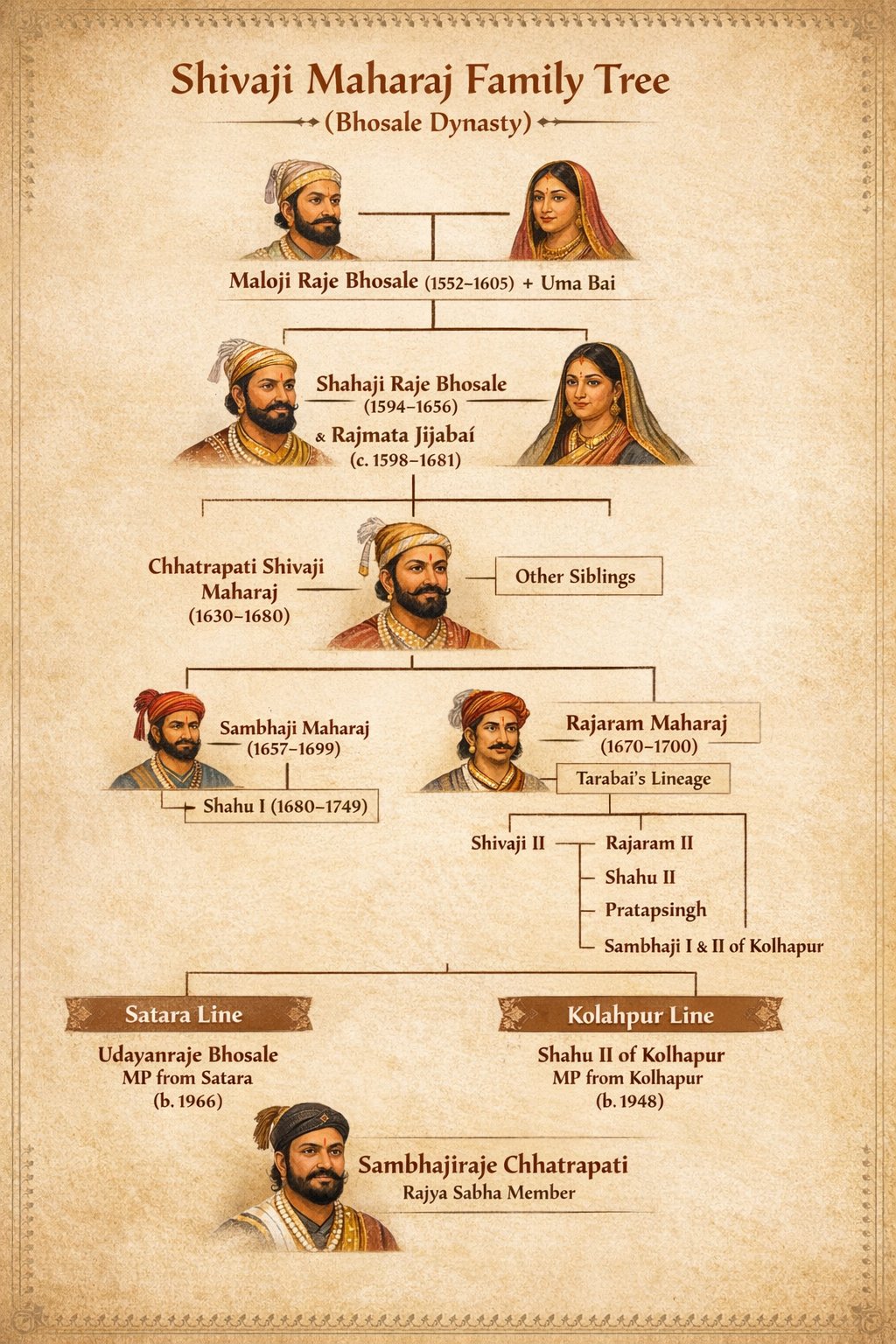
Shivaji’s Eight Wives and Their Children
| Wife Name | Family | Main Children | Role/Status |
|---|---|---|---|
| Saibai | Nimbalkar | Sambhaji, Sakhubai, Ranubai, Ambikabai | First wife, most beloved |
| Soyarabai | Mohite | Rajaram, Deepabai | Political alliance |
| Putalabai | Palkar | — | Committed Sati |
| Sakvarbai | Gaikwad | — | Imprisoned by Mughals |
| Sagunabai | Shirke | — | Maintained household |
| Kashibai | Jadhav | — | Political connection |
| Lakshmibai | Vichare | — | Royal alliance |
| Gunvantibai | Ingale | — | Extended family connection |
Understanding the Two Branches: Why the Empire Split
By now, you’ve learned that after Shivaji’s death, the Maratha Empire split into two main branches: Satara and Kolhapur. Let me clarify this for you because it’s often confusing.
The Satara Lineage: The Administrative Center
The Key Figure: Shahu I
After Sambhaji’s execution and Rajaram’s death, Shahu I (Sambhaji’s son) became the Chhatrapati of Satara. Shahu I is crucial because he brought stability and expansion to the Maratha territories. Under his watch (and later under the Peshwas), the Maratha Empire expanded significantly.
The Satara lineage kept the title of Chhatrapati but gradually gave more and more power to the Peshwas. By the time of the later Chhatrapatis, the Peshwa was effectively the real ruler, while the Chhatrapati became more of a ceremonial and spiritual leader.
Why Satara Remained Important
Satara remained important because:
-
It was the capital of the Maratha Empire
-
The Chhatrapati based there was considered the head of the Maratha confederacy
-
Later, when the British conquered the Peshwas, they ruled through the Satara Chhatrapati to maintain legitimacy
The Kolhapur Lineage: The Warrior Line
The Key Figure: Tarabai
The Kolhapur lineage emerged primarily due to Tarabai’s efforts and later consolidated under her sons and successors. Kolhapur developed as a separate, independent principality with its own Chhatrapati.
Why Kolhapur Became Important
Kolhapur became important because:
-
Tarabai kept the Maratha spirit alive during conflict between Shahu I and Rajaram’s line
-
It eventually became its own independent state
-
Kolhapur became known as a progressive princely state during the British Raj
-
It maintained its own army, administration, and cultural institutions
The Difference Between the Two
Here’s the key difference: The Satara lineage eventually became the “official” Maratha power because Shahu I won the civil war, but the Kolhapur lineage remained independent and important, especially in regional matters. Both branches today produce descendants who are active in Indian politics and society.
The Daughters and Their Legacy: Often Forgotten, Never Unimportant
When we talk about royal families, we often focus on the sons because they inherit the throne. But Shivaji’s daughters were just as important to the empire’s stability.
Sakhubai: The Connection to the Nimbalkar’s
Sakhubai, born from Shivaji and Saibai’s union, married into the Nimbalkar family (the same family that her mother Saibai came from). This marriage strengthened the bond between the Bhosales and the Nimbalkar, ensuring military support and trade partnerships.
Ranubai: The Jadhav Alliance
Ranubai married Udaji Jadhav, connecting the Bhosales to the influential Jadhav clan. The Jadhavs controlled significant territories in the Deccan and were important allies.
Ambikabai: The Mahadik Connection
Ambikabai was married to Amar Singh Mahadik, strengthening ties with yet another influential family. These marriage alliances were like creating a safety net—if one region faced trouble, allied families could support each other.
The Principle Behind These Marriages
What you need to understand is that royal marriages weren’t about individual love alone (though some certainly had affection). They were about creating political networks. When you marry your daughter into another noble family, you’re essentially saying: “Your daughter is precious to me. If you harm her or her children, there will be consequences. Let’s be allies instead.”
This is why even though these daughters didn’t rule directly, their children—Shivaji’s grandsons and granddaughters—formed the backbone of the extended Maratha network across the Deccan.
FAQ: Questions You Might Have About Shivaji’s Family
Who was Shivaji Maharaj’s first wife?
A: Saibai, daughter of Laxmanrao Nimbalkar. She was Shivaji’s most beloved wife and the mother of his eldest son, Sambhaji. She died young in 1659, deeply affecting Shivaji.
How many wives did Shivaji Maharaj have?
A: Eight wives. While this number might surprise modern readers, it was a strategic practice among 17th-century royalty. Each marriage allied the Bhosales with powerful families across the Deccan. The most important wives were Saibai (who gave him Sambhaji) and Soyarabai (who gave him Rajaram).
Who is the current descendant of Shivaji Maharaj?
A: There are many living descendants, but the most prominent are Chhatrapati Shahu II of Kolhapur (born 1948), the 12th direct descendant, and Udayanraje Bhosale of Satara (born 1966), the 13th direct descendant. Both are currently Members of Parliament as of 2024.
How many children did Shivaji Maharaj have?
A: Shivaji had eight children total—two sons and six daughters. The sons were Sambhaji and Rajaram, both of whom became Chhatrapati. The daughters were Sakhubai, Ranubai, Ambikabai, Deepabai, Rajkunvarbai, and Kamlabai.
What happened to Sambhaji Maharaj?
A: Sambhaji was Shivaji’s eldest son and became the second Chhatrapati after Shivaji’s death. However, he faced intense pressure from the Mughal Emperor Aurangzeb. After military defeats, Sambhaji was captured by the Mughals in 1689 and executed. His death marked a difficult period for the Maratha Empire, though his younger brother Rajaram continued the struggle.
Who was Tarabai?
A: Tarabai was the widow of Rajaram Maharaj (Shivaji’s second son) and one of India’s greatest warrior queens. After her husband’s death in 1700, she ruled as regent for her young son. For about 22 years across three different periods, she led military campaigns, negotiated with the Mughals, and kept the Maratha territories independent. She’s a symbol of female leadership and courage.
What’s the difference between the Satara and Kolhapur lineages?
A: After Shivaji’s death, the Maratha Empire eventually split into two branches. The Satara lineage descended from Sambhaji Maharaj (through his son Shahu I) and became the administrative center of the Maratha Confederacy under the Peshwas. The Kolhapur lineage descended from Rajaram Maharaj and remained an independent principality, especially under Tarabai’s influence. Both lineages produced rulers and both continue today.
Who was Jijabai?
A: Jijabai was Shivaji’s mother and one of the most influential women in Indian history. While Shivaji’s father Shahaji served various sultanates, it was Jijabai who raised young Shivaji with values of independence, justice, and Hindu pride. She inspired him with stories of past Hindu glory and essentially created the visionary leader that Shivaji became. Many historians credit her as the real architect of the Maratha Empire.
Are there any modern descendants of Shivaji in Indian politics?
A: Yes! Both Chhatrapati Shahu II of Kolhapur (Congress MP from Kolhapur, elected 2024) and Udayanraje Bhosale (BJP MP from Satara, elected 2024) are direct descendants of Shivaji Maharaj. Additionally, Sambhajiraje Chhatrapati, son of Shahu II, is a Rajya Sabha member.
How is the Bhosale family name spelled differently?
A: The Bhosale family name is sometimes spelled “Bhonsle” or “Bhosale.” The spelling varies depending on the historical source, the language used, and transliteration from Marathi. Both spellings refer to the same royal family.
The Enduring Legacy of the Bhosale Dynasty
When you study the family tree of Chhatrapati Shivaji Maharaj, you’re not just learning about one man. You’re learning about an entire family system that created one of history’s most important empires. From Maloji Raje, the ambitious administrator, to Rajmata Jijabai, the visionary mother, from Shivaji himself to his wives and children—each member of this family contributed to a legacy that changed India.
The Bhosale Dynasty didn’t just rule; they inspired. They showed that it was possible to stand up to the mighty Mughals and create something new. They demonstrated that good governance, strategic alliances, and respect for the common people could create an empire that lasted centuries. They proved that women could be warriors, administrators, and leaders. They showed that leadership wasn’t about conquest alone—it was about building systems that survived their founders.
Today, as you read this article, descendants of this dynasty are sitting in India’s Parliament. They’re making laws that affect hundreds of millions of people. They’re carrying forward the legacy of Swarajya—self-rule—that Shivaji fought for. This is the power of a strong family, strong values, and a vision for the future.
The Maratha Empire may have ended as a political entity, but the Bhosale family continues. Their values of courage, wisdom, and service to the people remain alive. Whether you’re a student of history, a supporter of Maratha heritage, or simply someone interested in Indian royal families, understanding the Bhosale lineage helps you understand India itself.
What do you think about the legacy of Shivaji and his family? Have you visited any Maratha historical sites or learned about this period in school? Share your thoughts and experiences in the comments below! And if you found this article valuable, please share it with others who might be interested in Indian history. Let’s keep these stories alive.