
Last updated on: July 30, 2026
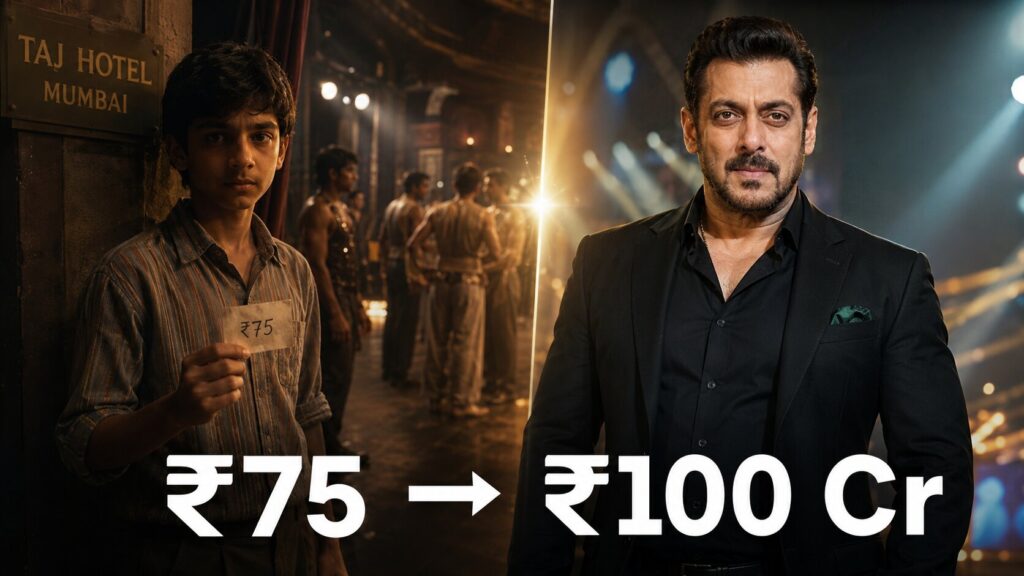
A 14-year-old boy stood at the back of a stage at the Taj Hotel in Mumbai, moving to the music while the main performers took the light. Someone paid him ₹75 for it. He later said he did it “just for fun” because a friend had brought him along.
Today that same man is Salman Khan, one of the highest-paid actors in the country, routinely associated with fees of ₹100 crore and more. The distance between those two numbers is almost absurd. It is also the part of the story most people feel when they search for his first salary: not the glamour of the ending, but the quiet fact of how small the beginning actually was.
The Actual First Paycheck
The amount was ₹75. The work was background dancing at a show in the Taj Hotel. He was around 14. In an old interview with PTI he put it simply:
“My first salary was, I think, about Rs 75. I was dancing behind in some show in the Taj hotel. One of my friends was dancing there so he took me (and I did it) just for fun.”
He has repeated the same recollection in later appearances, including on Aap Ki Adalat. There is no elaborate origin myth attached to it. A friend was going. He went. He stood at the back. He was paid seventy-five rupees.
That was the first money he earned for performing.
The Quiet Progression
After the ₹75 came the next small steps, still far from any idea of stardom.
- ₹750 for a Campa Cola advertisement.
- Then ₹1,500 — and that figure stayed the same for a long stretch.
- Around ₹11,000 for a supporting role in Biwi Ho To Aisi (1988), his actual film debut. He even used his own clothes for the shoot.
- For Maine Pyar Kiya (1989) the initial fee was ₹31,000. After the makers saw his work it was raised to ₹75,000.
These are not dramatic leaps. They are the kind of incremental, almost invisible climbs that most careers actually contain. The jump from background dancer to small-role actor to lead in a hit film still took years of ordinary, underpaid work. Most people give up somewhere in that middle stretch — the long stretch of ₹1,500, the small supporting part, the months when nothing seems to move.
The Deeper Truth Most Articles Skip
Salman Khan is the son of screenwriter Salim Khan. He came from a film family. That fact is real and it mattered later. Yet the first paid work was still standing at the back of a stage for ₹75. Privilege opened certain doors eventually; it did not hand him a starring role or a meaningful cheque on day one.
The early phase remained small and largely invisible. The real shift was not the money itself. It was treating even the “just for fun” work seriously enough that people began to notice. After Maine Pyar Kiya became a massive success, the story still did not become linear. He has spoken openly about having no work for four to six months afterwards. The industry largely credited his co-star, and offers dried up until his father helped create some momentum and Ramesh Taurani stepped in. Even a hit did not magically erase the dry periods.
That is the part that rarely appears in the short versions of the story: the family name existed, the early work was still tiny, and the climb stayed uneven long after the first big success.
What This Story Quietly Gives the Reader
Starting ridiculously small does not decide your ceiling. A fourteen-year-old taking ₹75 for standing at the back of a stage is not a prophecy of failure or of greatness. It is simply a beginning. Early money is often absurdly low. The real value in those first jobs is rarely the amount deposited. It is the experience of showing up, the small proof that you can do the work, and the quiet accumulation of days when almost no one is watching.
Visibility and respect usually arrive later. The first phase of most real careers is invisible and underpaid. Comparing your Chapter 1 to someone else’s Chapter 30 is the fastest way to feel defeated. The boy at the Taj Hotel and the man who now commands nine-figure fees are the same person, but they are separated by decades of ordinary, uneven work. The story does not ask you to become him. It simply shows that the distance between those two points is real, and that the early numbers do not lock the later ones in place.
Closing Reflection
The boy who took ₹75 for dancing at the back eventually became one of the highest-paid actors in the country. Not because the first paycheck was special, and not because the path stayed clean after the first big hit. He kept showing up after it. That is the part that remains when the numbers stop being interesting.
FAQs
Wait, was Salman Khan’s first salary really only 75 rupees? That can’t be right
Yes. He himself said it multiple times. ₹75 for dancing in the background at a Taj Hotel show when he was around 14.
But he is Salim Khan’s son… how come his first money was so less?
Family name helped later, but the first actual paid work was still that background dancing gig. The industry didn’t hand him a big cheque on day one.
What about his first film? How much did he get for Biwi Ho To Aisi or Maine Pyar Kiya?
Biwi Ho To Aisi (small role) – around ₹11,000. Maine Pyar Kiya – started at ₹31,000, later raised to ₹75,000 after they saw his work.
Did he really struggle or is this just a PR story?
He has spoken about having no work for months even after Maine Pyar Kiya became a hit. The early phase had real dry periods.
I earn very little right now and feel stuck. Does this story even help me?
It helps if you take the right lesson. The useful part is not “he became rich.” The useful part is that the first paid work was tiny, almost invisible, and he still treated it as a beginning instead of an insult.
Is there any video or interview where he talks about the ₹75?
Yes. He has mentioned it in older PTI interviews and later on shows like Aap Ki Adalat. The quotes are consistent across years.