
Last updated on: June 12, 2026
We’ve been taught the wrong way to change.
Fight the urge. White-knuckle through it. Build more willpower.
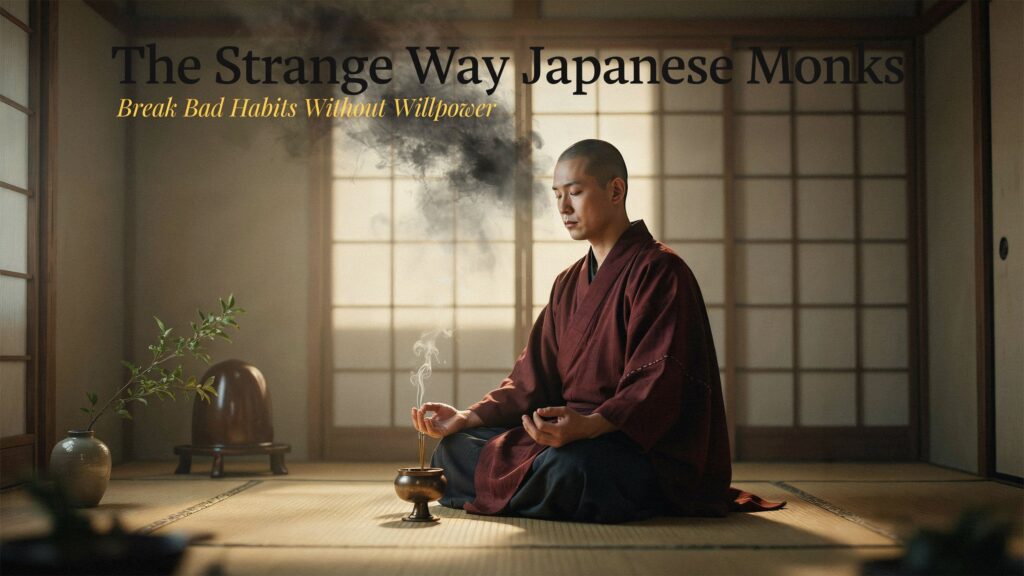
Japanese Zen monks take the opposite approach — and it works better.
Instead of battling cravings, they quietly redesign the environment, the ritual, and the relationship with the urge itself. The result? Habits dissolve with far less struggle.
I spent time studying traditional Zen practices and talking to people who’ve applied these methods in modern life. Here’s what actually works — and why it feels so strangely effective.
1. They Don’t Fight the Habit — They Observe It
Western culture says: Resist the craving. Suppress it. Be stronger.
Zen monks say: Watch it like a cloud passing in the sky.
When an urge arises (for smoking, scrolling, sugar, anger, whatever), they don’t immediately try to stop it. They sit with it. They get curious. They notice where it lives in the body, what triggered it, how it changes over time.
This simple act of non-judgmental observation creates space. The urge loses its power when it’s no longer being fed by resistance. Many people who try this report the craving peaks and then naturally fades within minutes — without any willpower battle.
Modern application: Next time you feel the pull of a bad habit, pause for 60 seconds and just watch it. Describe it neutrally in your head (“tightness in chest, restless energy”). Don’t try to stop it. Just observe.
2. They Design the Environment So the Habit Becomes Difficult
Monks live in intentionally simple spaces. No distractions. Everything has its place. The environment itself supports discipline.
They understand that willpower is unreliable. So they remove the need for it.
- No tempting snacks lying around.
- Structured daily schedule with almost no “empty time” where bad habits thrive.
- Physical cues that remind them of their practice.
Modern twist:
- Want to stop mindless scrolling? Put your phone in another room or use grayscale mode.
- Want to eat healthier? Don’t keep junk food in the house.
- Want to wake up earlier? Put your alarm across the room and prepare your morning routine the night before.
The monks don’t rely on motivation. They make the right action the path of least resistance.
3. They Replace, Don’t Remove
Instead of just stopping a bad habit, they replace it with a better one that serves a similar purpose.
A monk struggling with anger doesn’t just “stop getting angry.” He replaces the energy with a ritual — bowing, breathing, walking meditation.
The craving for distraction gets replaced with a short zazen (sitting meditation) or cleaning.
Practical examples:
- Instead of evening wine to unwind → herbal tea + journaling
- Instead of doom-scrolling → 10-minute walk or reading
- Instead of emotional eating → drinking water and naming the emotion
The key is finding a replacement that gives similar relief or reward.
4. They Turn Everything Into Ritual
Monks don’t have “habits.” They have rituals.
Every action — eating, cleaning, walking, even using the toilet — is done with full presence and care. This transforms mundane tasks into practice.
When you bring ritual and mindfulness to daily actions, bad habits have less room to hide in autopilot.
Try this: Turn one daily activity (making tea, brushing teeth, folding laundry) into a small ceremony. Do it slowly, attentively, without distractions. Notice how it changes the experience.
5. They Focus on Identity, Not Willpower
A monk doesn’t say “I’m trying to stop smoking.”
He lives as someone who simply doesn’t smoke. The identity comes first. The behavior follows.
This is why forcing change through sheer willpower often fails — it fights against your current self-image.
Modern version: Instead of “I’m trying to eat healthier,” start thinking “I am someone who values how I feel after eating.” Small actions then become natural expressions of that identity.
Why This Approach Feels So Different (And Effective)
Willpower is finite. Environment, identity, observation, and ritual are renewable.
Japanese monastic training has refined these methods over centuries. They don’t fight human nature — they work with it.
People who’ve applied these ideas report the same thing: the habits that once felt impossible to break simply lose their grip when you stop fighting them directly.
How to Start Today (Without Becoming a Monk)
Pick one bad habit you want to change.
Then apply just one of these methods:
- Observe the urge without judgment for a week
- Redesign your environment to make the habit harder
- Find a positive replacement ritual
- Turn the replacement into a small daily ceremony
- Shift your identity language (“I am someone who…”)
Small, consistent experiments beat heroic willpower every time.
Have you ever tried a non-willpower approach to breaking a habit? Or do you have a story of a tiny change that had big results?
Share in the comments — I read every one.
The path to freedom isn’t always through more force. Sometimes it’s through smarter, gentler design.