
Last updated on: June 27, 2026
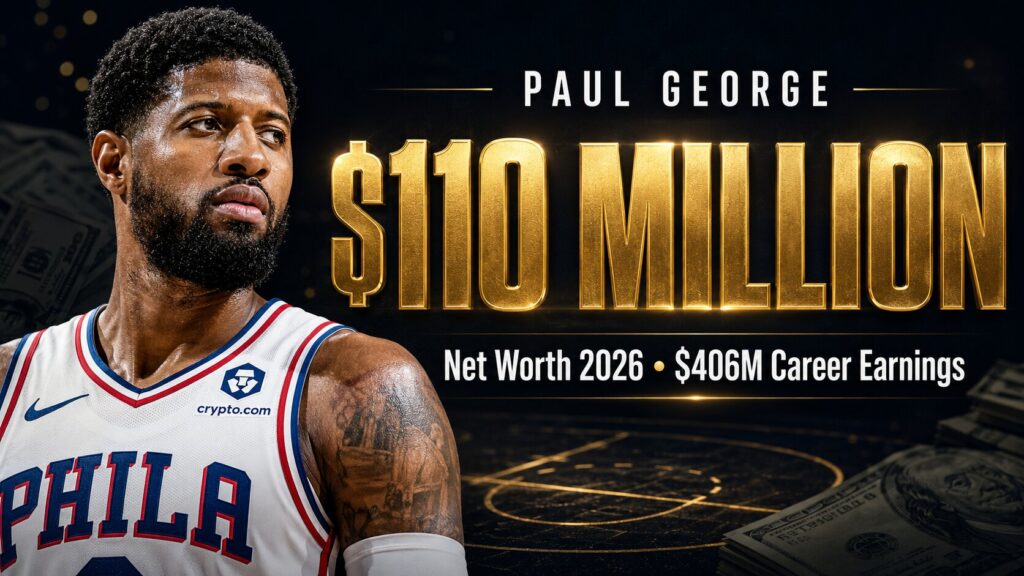
Paul George sits at roughly $110 million in net worth as of 2026. That number comes from Celebrity Net Worth and lines up with the broader picture of his finances. It is not a headline-grabbing billionaire figure, but it reflects something more interesting: steady, high-level accumulation over 15 NBA seasons without the flashiest endorsement portfolio or a single massive side business.
Most of it traces back to the court. George has now cleared more than $406 million in NBA salary alone, according to Spotrac data through the 2025-26 season. Add in consistent off-court money from Nike and a handful of other partners, plus a handful of quiet investments, and the math starts to make sense. The current four-year, $211.58 million max contract he signed with the Philadelphia 76ers in the summer of 2024 simply accelerated the climb.
Current Net Worth Estimate
Different outlets land in a similar ballpark. Celebrity Net Worth has held at $110 million for a while. Other estimates have floated between $90 million and $110 million depending on when they were published and how aggressively they factor in taxes, spending, and asset appreciation. Forbes, for its part, tracks annual earnings more closely — it listed George at $56.3 million for the 2025 calendar year (roughly $49.3 million on-court and $7 million off-court).
Net worth is always an estimate. It factors in cash, investments, real estate equity, and brand value minus liabilities. For a player like George, who has been a max-level earner since his mid-20s, the bulk sits in liquid or semi-liquid assets rather than a single flashy business. The $110 million mark feels reasonable given the salary trajectory and the fact that he has avoided the kind of off-court disasters that have dinged other athletes’ balance sheets.
The Salary Backbone: $406 Million and Counting
Nothing moves the needle like the NBA paycheck. George entered the league in 2010 as the 10th overall pick by the Indiana Pacers on a modest rookie-scale deal. The real money started flowing once he proved he could be a two-way star.
By the time he reached free agency in 2024, he had already banked the majority of his career earnings. Spotrac puts his total NBA salary at $406,203,976 through the 2025-26 season. That puts him among the top 10 highest career earners in league history at this point.
Here is how the money has stacked up in recent years:
Paul George Year-by-Year NBA Earnings (Selected Seasons)
| Season | Team | Salary | Notes |
|---|---|---|---|
| 2024-25 | Philadelphia 76ers | $49,205,800 | First year of new max deal |
| 2025-26 | Philadelphia 76ers | $51,666,090 | Fully guaranteed |
| 2026-27 | Philadelphia 76ers | $54,126,380 | Fully guaranteed |
| 2027-28 | Philadelphia 76ers | $56,586,670 | Player option |
| Career Total (thru 2025-26) | – | $406,203,976 | Across Pacers, Thunder, Clippers, 76ers |
The current deal with Philadelphia is a classic modern max: four years, $211.58 million, all guaranteed, average annual value of about $52.9 million. It includes a player option for the final season and a 15% trade bonus. George declined his player option with the Clippers to test free agency and landed the new pact in July 2024.
What stands out is the consistency. Even in seasons shortened by injury or lockout, George has rarely dipped below max or near-max money once he established himself. The jump from his early Pacers/Thunder deals (in the $15–30 million range) to the $40+ million annual figures of the last several years tells the real story of his wealth curve.
Endorsements: Steady Rather Than Spectacular
Salary is the engine, but endorsements add meaningful fuel. George has never been in the LeBron or Curry tier of off-court earners, yet he has maintained a solid portfolio for more than a decade.
Nike remains the cornerstone. He has had a signature shoe line (the PG series) since 2017 and continues to work closely with the brand even as the line has evolved. Estimates for his Nike deal have hovered around $5–5.5 million annually in recent years. Other long-term partners have included Gatorade, New Era (headwear fits his personal style), AT&T, Foot Locker, and Tissot.
Forbes has pegged his off-court earnings in the $5–7 million range in recent seasons. That is respectable but not eye-watering compared with global superstars. The money arrives reliably because George has stayed marketable: clean image, strong social following, and consistent All-Star level play when healthy. He has avoided the scandals that can kill deals overnight.
One interesting note: even after some reports suggested the signature shoe line paused or shifted focus, Nike has kept him in the fold. That longevity matters. A player who can keep a major apparel deal into his mid-30s is protecting a significant revenue stream that many peers lose once their on-court peak fades.
Investments and Assets: The Quiet Diversifiers
Public information on George’s investment portfolio is thinner than his contract details, which is common for active players who prefer privacy. What surfaces points to selective, mostly passive stakes rather than a sprawling business empire.
He has participated in funding rounds for companies such as Mountaintop Studios (gaming), AvantStay (hospitality/real estate), and Tonal (connected fitness). These are not massive controlling positions, but they represent the kind of calculated diversification many smart athletes pursue in their 30s.
Real estate forms another piece. George has owned property in the Los Angeles area, including a home in Pacific Palisades purchased around the time he joined the Clippers. High-end Southern California real estate has appreciated sharply in recent years, so that asset has likely grown in value alongside his salary.
The rest of the picture is standard for a high-earning athlete: vehicles, collectibles, and cash reserves managed by advisors. There are no public reports of major business failures or outsized wins that would dramatically swing the net worth number either way. That stability itself is a quiet win.
How the Net Worth Has Grown Over Time
George’s wealth curve has been more linear than explosive. He was already a millionaire by his early 20s thanks to the rookie deal and early extensions. The real acceleration happened between 2018 and 2024, when he was earning $30–45 million per season while still adding endorsement layers.
By the time he signed the 76ers deal in 2024, he had already cleared the $300 million career earnings mark. The new contract plus continued off-court income pushed him comfortably past $400 million in total NBA salary and into the $110 million net worth neighborhood.
Taxes and lifestyle spending obviously take a bite. California and Pennsylvania (his current team state) both have high state income taxes, and NBA salaries are taxed in every city the team plays. Still, the raw numbers are large enough that even after those hits and reasonable spending, the retained wealth is substantial.
What Comes Next: 2026 and Beyond
George turns 36 in May 2026. The 2026-27 season will pay him $54.1 million, followed by the $56.6 million player option year. If he stays healthy and performs, exercising that option or negotiating another short-term deal remains realistic. Even a modest two-year extension at age 37–38 would add another $40–50 million.
Post-playing career options look solid but not superstar-level. Broadcasting, front-office roles, or expanding his brand into apparel or media are all plausible. His Nike relationship and clean reputation give him a head start on any post-career business moves.
If he simply collects the remaining guaranteed money on his current deal and maintains even modest endorsement income for a few more years, another $30–40 million in earnings before retirement is very achievable. That would push career NBA salary past $450–500 million and likely lift net worth into the $130–150 million range depending on investment returns and spending.
The Bottom Line
Paul George’s net worth of roughly $110 million in 2026 is the product of longevity at the highest pay tier, disciplined brand partnerships, and a handful of smart investments. It lacks the explosive side-hustle stories of some peers, but it also lacks the volatility. In an era when max contracts routinely exceed $200 million and the salary cap keeps climbing, George has simply been one of the most consistently compensated players of his generation.
The money will continue to compound quietly as long as he stays on the court and manages the off-court side with the same steadiness he has shown for the past decade-plus. For most athletes, that kind of sustained high-level earning power is the real measure of financial success.